Rome is the city of the Colosseum, the Trevi Fountain and long lunches in sunny piazzas. It is also a city where people were thrown off a cliff for treason, killed by animals for an afternoon's entertainment, burned alive for their ideas and beheaded on a bridge that tourists now cross with gelato in hand. Its 20th century added a massacre in a quarry, a ghetto emptied in one morning and a former prime minister's body left in the boot of a car.
Rome is unusually good at keeping its evidence. Most of these stories happened somewhere you can still stand: a prison cell under a church, a statue on a market square, a plaque on a side street near the Jewish quarter. This guide follows them in order, from the early Republic to the present, and tells you where to find each one. The last section has a walking route and some notes on visiting the more recent memorials with care.
Thrown From the Tarpeian Rock
Long before the Colosseum, Rome had a simpler way of dealing with traitors. The Tarpeian Rock is a cliff about 25 metres high on the south side of the Capitoline Hill. Murderers, traitors, perjurers and slaves convicted of theft were thrown from it. The victims named in the sources include Spurius Cassius in 485 BC, the former consul Marcus Manlius Capitolinus in 384 BC, condemned for sedition, and the wealthy Sextus Marius in AD 33.
 Sextus Marius thrown from the Tarpeian Rock in AD 33, imagined by a 19th-century illustrator. Image: Josep Serra i Porsón, Public domain, via Wikimedia Commons.
Where to see it today: the cliff face is visible from the Piazza della Consolazione side of the Capitoline, a few minutes' walk from the Roman Forum. It is an unremarkable bank of rock and greenery today, which makes it more unsettling once you know what it was for.
The Mamertine Prison
At the foot of the Capitoline, under a church, is the Tullianum, better known as the Mamertine Prison. It was not a prison in the modern sense. Rome rarely locked people up for long; the Tullianum was where enemies of the state waited to die.
Two of its most famous prisoners were foreign kings. Jugurtha of Numidia died there in 104 BC after being paraded in Marius's triumph; whether he was starved or executed is still debated. Vercingetorix, the Gaulish chieftain who had led the revolt against Julius Caesar, was held captive for six years and executed in 46 BC, probably by strangulation, after Caesar's triumph. The conspirators of Catiline are traditionally said to have been strangled here in 63 BC.
A later Christian tradition holds that Saint Peter was imprisoned here and baptised his guards with water from a spring in the floor. That is tradition, not history: the spring was there long before him.
 The church of San Giuseppe dei Falegnami, built over the Mamertine Prison. Image: SurreyJohn, CC BY-SA 4.0, via Wikimedia Commons.
Where to see it today: Clivo Argentario 1, by the Roman Forum (Metro B, Colosseo). The prison is open to visitors with a ticket, usually from about 9:00. The lower cell is reached by stairs and is not wheelchair accessible.
Caesar's Last Steps: Largo di Torre Argentina
On 15 March 44 BC, Julius Caesar was stabbed to death by a group of senators at a meeting in the Curia of Pompey, a hall attached to Pompey's theatre complex. What survives of it is part of the foundation and a low wall behind two of the temples in the sunken square now called Largo di Torre Argentina. The identification relies partly on the remains of latrines that ancient writers mention nearby.
 The sunken ruins of Largo di Torre Argentina, where part of the Curia of Pompey survives. Image: Sonse, CC BY 2.0, via Wikimedia Commons.
For decades you could only look down into the ruins from the street. In June 2023, walkways and lighting funded by Bulgari opened the site to visitors, with a lift platform for step-free access.
Where to see it today: Largo di Torre Argentina, in the centre between the Pantheon and the Jewish quarter. You can see the ruins from the pavement for free. To walk among them, book ahead; the site is closed on Mondays.
Death as Entertainment: the Colosseum
The Flavian Amphitheatre, the Colosseum, opened under the emperor Titus in AD 80 with games lasting more than 100 days. According to the historian Cassius Dio, about 9,000 animals were killed during them. Other ancient writers give lower figures.
The day's programme followed a fixed shape. Animal hunts filled the morning, gladiators fought in the afternoon, and in between, around midday, condemned criminals were executed, often by animals. The poet Martial describes executions staged as myths: a man playing the bandit Laureolus was crucified and mauled by a bear, and another, dressed as Orpheus, was torn apart.
 Pollice Verso ("Thumbs Down"), Jean-Léon Gérôme's 1872 vision of the arena. Image: Jean-Léon Gérôme, Public domain, via Wikimedia Commons.
Under the arena floor is the hypogeum, a maze of tunnels, cages and lifts that raised animals and scenery into view.
Where to see it today: the arena floor and the hypogeum are only included on the official "Full Experience" ticket, which also covers the Forum and Palatine. Tickets go on sale 30 days ahead on the official Colosseum website and sell out quickly. Buy only there: see the section on modern Rome below.
The Great Fire of AD 64
On the night of 18 to 19 July AD 64, a fire broke out in shops near the Circus Maximus. It burned for six days, died down, then flared up again for three more. Of Rome's 14 districts, three were destroyed completely and seven badly damaged.
Nero was at Antium, about 35 miles away, when it started. The famous image of him fiddling while Rome burned is a later story and not reliable. What happened next is better documented. According to the historian Tacitus, Nero blamed the fire on the city's Christians, who were torn apart by dogs, crucified, or set alight to serve as torches at night. Historians still debate how far that passage can be trusted, but it became the founding image of Roman persecution.
 Nero's Torches by Henryk Siemiradzki (1876), based on Tacitus's account. Image: Henryk Siemiradzki, Public domain, via Wikimedia Commons.
Nero then used the cleared land to build a vast new palace, the Domus Aurea or Golden House.
Where to see it today: the surviving rooms of the Domus Aurea, on the Oppian Hill near the Colosseum, can be visited on guided tours only, on Friday to Sunday. Book through the Colosseum archaeological park.
1527: The Sack of Rome
On 6 May 1527, an unpaid and mutinous imperial army of around 14,000 German Landsknechts and 6,000 Spanish soldiers stormed Rome. Their commander, the Duke of Bourbon, was killed in the assault, and nothing held them back after that.
At St Peter's, 147 of the Pope's 189 Swiss Guards died covering his escape. Clement VII fled along the Passetto, the raised corridor linking the Vatican to Castel Sant'Angelo, and was held there until June, when he agreed to a ransom of 400,000 ducats. Rome's population fell from more than 55,000 to about 10,000; estimates of the dead range from 6,000 to 12,000.
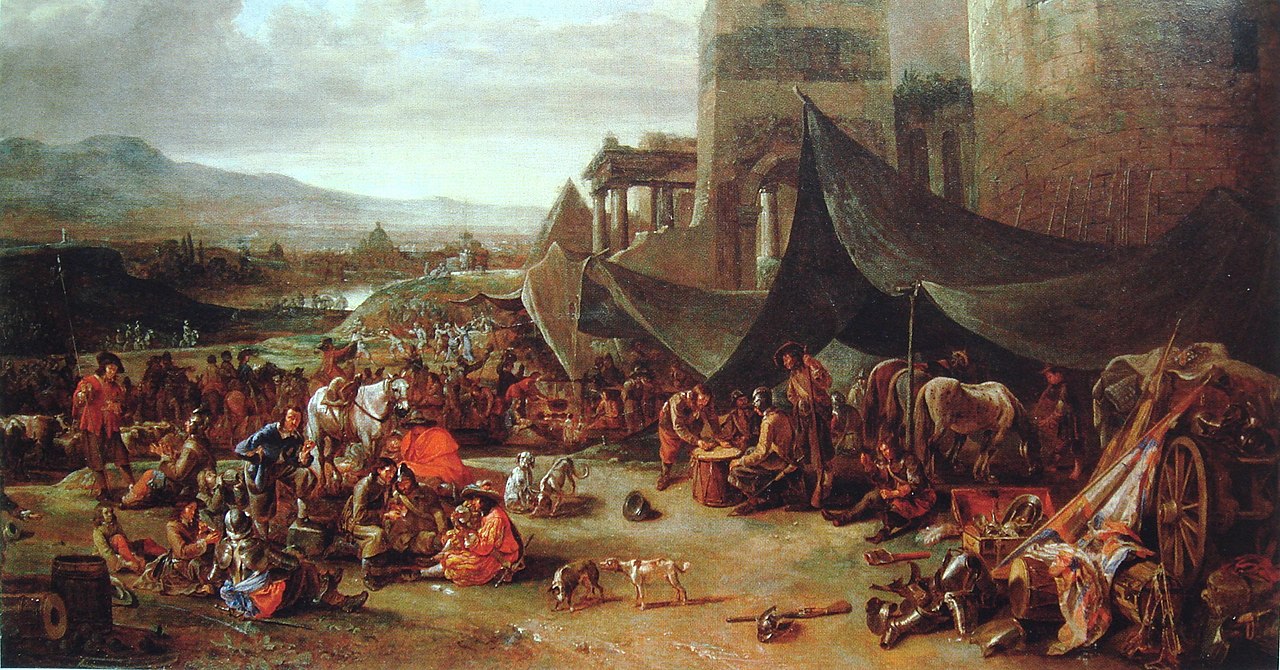 The Sack of Rome in 1527, painted by Johannes Lingelbach in the 17th century. Image: Johannes Lingelbach, Public domain, via Wikimedia Commons.
Where to see it today: the Passetto still runs along its wall from the Vatican to Castel Sant'Angelo. New Swiss Guards are sworn in every 6 May, the anniversary of the stand on the steps.
The Ghetto, 1555–1870
On 14 July 1555, Pope Paul IV issued the bull Cum nimis absurdum, ordering Rome's Jews into a walled enclosure on the low, flood-prone land beside the Tiber. The Roman Ghetto lasted more than three centuries. It ended only with the fall of the Papal States in 1870, and its walls were demolished in 1888.
The neighbourhood is now one of the most attractive corners of central Rome, full of restaurants serving Roman-Jewish dishes. Its darkest day came later: see the section on the occupation below.
Where to see it today: the Jewish Museum of Rome (Museo Ebraico), in the complex of the Great Synagogue on Via Catalana. The visit includes the Great Synagogue and the smaller Spanish one. Photography is not allowed inside.
Burned in Campo de' Fiori, Beheaded on Ponte Sant'Angelo
Two executions a few months apart still shape how Romans remember papal justice.
On 11 September 1599, Beatrice Cenci was beheaded on the square at the end of Ponte Sant'Angelo, together with her stepmother Lucrezia. Her brother Giacomo was tortured, killed with a mallet and quartered. Their youngest brother, Bernardo, aged 12, was spared but made to watch, then sent to the galleys. The family had been convicted of murdering Beatrice's father, Francesco Cenci, a violent man, in 1598. In the version Romans have told ever since, he had abused his daughter for years. Popular sympathy turned her into a legend. She is buried at San Pietro in Montorio, and Romans say her ghost crosses the bridge carrying her head on the night before every 11 September.
 The portrait long said to show Beatrice Cenci. Once credited to Guido Reni, it is now thought to be by another hand and may not show her at all. Image: Attributed to Ginevra Cantofoli / Formerly attributed to Guido Reni, Public domain, via Wikimedia Commons.
Five months later, on 17 February 1600, the philosopher Giordano Bruno, condemned by the Inquisition as a heretic, was burned alive in Campo de' Fiori. He was stripped and gagged so he could not speak to the crowd. The same square had seen copies of the Talmud burned in 1553.
In 1889, after the end of papal rule, a statue of Bruno by Ettore Ferrari was raised on the spot where the pyre stood. It faces towards the Vatican, and its inscription reads: "To Bruno, from the age he foresaw, here where the pyre burned."
 Ettore Ferrari's statue of Giordano Bruno in Campo de' Fiori, unveiled in 1889 on the site of his execution. Image: Livioandronico2013, CC BY-SA 4.0, via Wikimedia Commons.
For most of the 19th century, papal executions were carried out by one man: Giovanni Battista Bugatti, known as Mastro Titta, the papal executioner from 1796 to 1864. His own notebook lists 516 executions. His red cloak is kept in Rome's Museo Criminologico on Via del Gonfalone, which has been closed for long periods; check before you go.
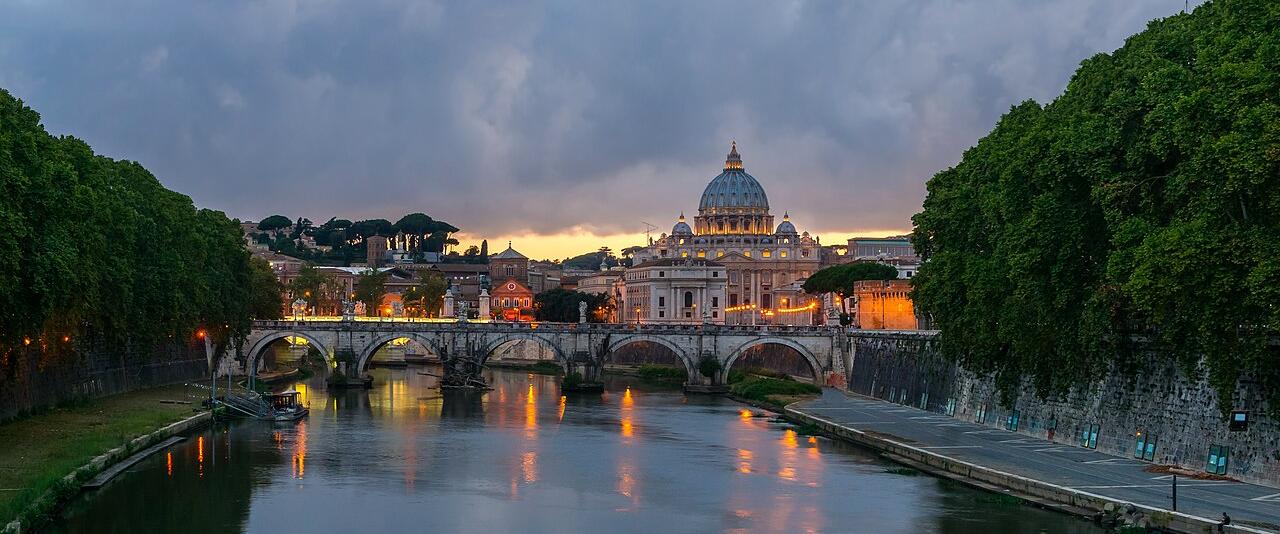
Where to see it today: Campo de' Fiori, which still holds a morning market around the statue, and Ponte Sant'Angelo, best crossed at dusk with Castel Sant'Angelo ahead of you.
The Capuchin Crypt
Beneath the church of Santa Maria della Concezione on Via Veneto lie the bones of about 3,700 Capuchin friars, arranged into arches, chandeliers and wall patterns across a series of small chapels. When the friars moved to this site in 1631, they brought 300 cartloads of their brothers' remains with them. A placard in the crypt addresses visitors directly: "What you are now, we used to be; what we are now, you will be."
 One of the chapels of the Capuchin Crypt, decorated with the bones of friars. Image: Anil Öztas, CC BY 4.0, via Wikimedia Commons.
Where to see it today: Via Vittorio Veneto 27, as part of the Capuchin museum. Photography is strictly forbidden and shoulders and knees must be covered.
Fascism and Occupation, 1922–1944
Mussolini rebuilt central Rome as a stage for his regime. To cut a straight parade road from the Colosseum to Piazza Venezia, opened on 28 October 1932 as Via dell'Impero, the Alessandrino quarter and much of the Velia hill were demolished, three churches among them, and 746 poor families were moved to the outskirts. The road, now Via dei Fori Imperiali, is still one of the city's great views, and the reason ancient forums lie on either side of a busy road.
The worst came after Italy's armistice in September 1943, when Germany occupied Rome. Late that month, the SS commander Herbert Kappler demanded 50 kilograms of gold from Rome's Jews in return for their safety; they delivered it within two days. On 16 October 1943, the Germans raided the old ghetto anyway. They detained 1,259 people, released about 236 non-Jews, and two days later deported 1,023 to Auschwitz from Tiburtina station. Sixteen came back: fifteen men and one woman.
The SS ran a prison at Via Tasso 145, where resisters were interrogated and tortured. Prisoners scratched messages and calendars into the walls of their cells, and those marks survive.
 A calendar scratched into a cell wall by a prisoner of the SS at Via Tasso. Image: Anthony M. from Rome, Italy, CC BY 2.0, via Wikimedia Commons.
On 23 March 1944, partisans bombed an SS police column on Via Rasella; the attack killed 33 soldiers. The German command ordered ten Italians to be killed for every dead German. The next day, 24 March, the Germans took 335 men and boys, 75 of them Jewish, to quarries on Via Ardeatina and shot them; five more than the quota were killed by mistake. The quarry entrances were then blown up. Kappler was sentenced to life in 1947 and escaped in 1977. Erich Priebke, one of the officers who led the killing, was found living in Argentina in 1994, convicted in 1998, and died under house arrest in 2013.
Where to see it today:
- Museo Storico della Liberazione, Via Tasso 145, in the former SS prison. Open daily, free.
- Mausoleo delle Fosse Ardeatine, Via Ardeatina 174, built on the site of the massacre and opened in 1949: 335 tombs in a long, low hall under a single slab of concrete. Open daily, with shorter hours at weekends.
- Stolpersteine, small brass "stumbling stones" set into the pavement outside the homes of deported Jews. The first in Italy were laid in Rome in 2010, and you will find them in the old ghetto streets.
The Years of Lead: Aldo Moro
On 16 March 1978, the Red Brigades ambushed former prime minister Aldo Moro on Via Mario Fani, in the north of the city. They killed all five of his bodyguards, Oreste Leonardi, Domenico Ricci, Raffaele Iozzino, Giulio Rivera and Francesco Zizzi, and took Moro away. For 55 days Italy argued over whether to negotiate. On 9 May 1978, his body was found in the boot of a red Renault 4 on Via Michelangelo Caetani, a narrow street almost exactly halfway between the headquarters of his Christian Democrats and the Communist Party, the two parties he had been trying to bring together.
Where to see it today: Via Caetani, a two-minute walk from Largo di Torre Argentina. A bronze plaque marks the spot where the car was parked, and Italy's president lays a wreath there every 9 May.
Modern Rome's Traps
Today's dark side is smaller, but you are more likely to meet it.
- The Trevi Fountain has charged €2 since 2 February 2026 to enter the area right beside the basin. Viewing it from the square is still free.
- The Spanish Steps are for walking, not sitting. Sitting or lying on them has been banned since 2019, with fines of €250 and up to €400 for damage.
- Bus 64, between Termini station and the Vatican, is known as the "pickpocket express" and has been named in foreign government travel advice. Keep bags zipped and in front of you.
- "Skip-the-line" sellers: in April 2025 Italy's competition authority fined Colosseum ticket resellers a total of €20 million for using bots to hoard cheap tickets and resell them at inflated prices. Buy from the official sites, not from touts on the street.
How to See Dark Rome Respectfully
A self-guided walk, about 4 km. Start at Ponte Sant'Angelo, where Beatrice Cenci died, then walk to Campo de' Fiori and Bruno's statue. Continue to Largo di Torre Argentina for Caesar, then to Via Caetani and the Moro plaque, two minutes away. From there it is a short walk into the old ghetto, the Jewish Museum and the Stolpersteine. Climb past the Tarpeian Rock on the Capitoline, go down to the Mamertine Prison by the Forum, and finish at the Colosseum.
Further afield:
- The Capuchin Crypt on Via Veneto.
- The Domus Aurea, near the Colosseum, at weekends.
- The Via Tasso museum, near San Giovanni in Laterano.
- The Fosse Ardeatine mausoleum, south of the walls near the Appian Way.
Dates the city remembers:
- 24 March: the Fosse Ardeatine massacre.
- 9 May: Aldo Moro, with the president's wreath on Via Caetani.
- 16 October: the 1943 raid on the ghetto.
A few ground rules. The 20th-century sites are memorials, and the families of those killed still live in Rome. Keep your voice down at the Fosse Ardeatine and on Via Caetani. Respect the photo ban and dress code at the Capuchin Crypt and the synagogue. And at the Colosseum, remember that the drama in the paintings was real for the people in the arena.