Everyone knows Florence for its art: the Duomo, the David, the Uffizi. Fewer visitors know how much else the city gave the world. It ran a volunteer ambulance service in the 13th century and one of Europe's first foundling hospitals in the 15th. It minted the coin that medieval Europe traded in, staged the first opera that survives complete, built the first piano, and in 1786 became the first state to abolish the death penalty. When the Arno flooded in 1966, young people came from all over the world to dig its books out of the mud.
Each of these chapters left something you can still see. This guide goes through them in order, from 1244 to 1966, and tells you where to find each one.
1244: The Misericordia
According to its own archive, the Misericordia di Firenze was founded in 1244, as a brotherhood of volunteers who carried the sick to hospital and the dead to burial. The stories about how it began, including one about a porter who fined his friends for swearing, are legends, but the brotherhood itself has never stopped. Its members nursed the sick through the plagues and went to the bomb sites at both ends of the Ponte Vecchio in 1944. For centuries they worked in black robes and hoods; since 2006 these have been worn only for ceremonies.
 The captains of the Misericordia hand over abandoned children to foster mothers, in a fresco of 1386. Image: Sailko, CC BY 3.0, via Wikimedia Commons.
Today the Misericordia is still a volunteer organisation, running ambulances, clinics and civil-protection work, more than seven centuries after it began.
Where to see it today: the Misericordia's headquarters stand on Piazza del Duomo, opposite Giotto's bell tower. Its museum, on the fourth floor, opened in 2016. Look on the façade for the plaque marking the height of the 1966 flood.
1252: The Florin
In 1252 Florence struck a gold coin of about 3.5 grams, with St John the Baptist on one side and the city's lily on the other. The florin kept its weight and purity for almost three centuries, and it became the coin that Europe's merchants trusted, copied and kept their accounts in. Florentine bankers carried it across the continent. They were also among the first to use double-entry bookkeeping: the oldest complete double-entry ledger that survives was kept by a Florentine firm in 1299–1300.
 A gold florin from 1317, with the Florentine lily. Image: sailko, CC BY-SA 3.0, via Wikimedia Commons.
Where to see it today: the city's lily is still everywhere, from the façade of Palazzo Vecchio to the manhole covers.
A legend worth knowing: a plaque in the church of Santa Maria Maggiore once credited a Florentine, Salvino degli Armati, with inventing eyeglasses. The claim was invented in the 17th century and disproved around 1920. What is true is that a friar preaching in Florence in 1306 spoke of spectacles invented about twenty years earlier. Their inventor is unknown.
1401–1436: The Doors and the Dome
In 1401 the cloth merchants' guild held a competition to design new bronze doors for the Baptistery. Seven sculptors each made a trial panel of the sacrifice of Isaac. Lorenzo Ghiberti won, and spent most of the rest of his life on the Baptistery's doors.
 The two surviving competition panels of 1401: Ghiberti's (left) and Brunelleschi's (right), now in the Bargello. Image: MenkinAlRire, CC BY-SA 4.0, via Wikimedia Commons.
The runner-up, Filippo Brunelleschi, went on to solve a problem that had defeated everyone for decades: how to roof the cathedral's huge octagonal crossing. Between 1420 and 1436 he built a dome without the usual wooden framework, using two shells, bricks laid in a herringbone pattern and chains of stone and iron. More than four million bricks went into it. It is still the largest masonry dome ever built.
 Brunelleschi's dome above the rooftops of Florence. Image: Vyacheslav Argenberg, CC BY 4.0, via Wikimedia Commons.
Where to see it today:
- The two surviving competition panels hang side by side in the Bargello.
- You can climb the 463 steps between the dome's two shells with the Brunelleschi Pass; book ahead and bring photo ID.
1445: The Foundling Hospital
In the 15th century, babies born to poor or unmarried mothers were often abandoned. In 1419 the silk merchants' guild commissioned Brunelleschi to build a hospital to take them in, and the Ospedale degli Innocenti received its first child on 5 February 1445. It is often called the first building of the Renaissance, and it was one of Europe's first institutions dedicated to abandoned children. From 1660 mothers could leave a baby anonymously on a revolving wheel, the ruota, which was used until the 19th century.
 The loggia of the Ospedale degli Innocenti on Piazza della Santissima Annunziata. Image: Ricardalovesmonuments, CC BY-SA 4.0, via Wikimedia Commons.
Above the arches of the loggia, Andrea della Robbia's blue-and-white roundels of swaddled babies have welcomed visitors since about 1490.
 One of Andrea della Robbia's roundels of swaddled babies on the loggia. Image: sailko, CC BY 2.5, via Wikimedia Commons.
The Innocenti never stopped working for children. It still runs a children's centre and family homes, and since 1988 the building has housed the UNICEF research office.
Where to see it today: the Museo degli Innocenti, Piazza della Santissima Annunziata 12, open daily from 10:00 to 19:00. The ruota can still be seen under the portico.
 The window of the foundling wheel under the portico. Image: Fred Cherrygarden, CC BY-SA 4.0, via Wikimedia Commons.
1583–1600: A Language and a New Art
Florence gave Italy its language. Dante, born here in 1265, wrote the Divine Comedy in the Florentine of his day, and centuries later educated Florentine became the model for standard Italian; the novelist Alessandro Manzoni famously went to Florence to "rinse his clothes in the Arno" and rewrite his novel in its speech. In 1583 a group of Florentines founded the Accademia della Crusca to protect the language. Its dictionary of 1612 became the model for dictionaries across Europe, and it is still working, the oldest linguistic academy in the world.
 The Sala delle Pale at the Accademia della Crusca, hung with its members' painted shovels. Image: Sailko, CC BY 3.0, via Wikimedia Commons.
A few years later, a circle of Florentine musicians and poets, trying to revive the way they believed ancient Greek drama had been performed, invented opera. Jacopo Peri's Dafne was performed in 1598, but its music is lost. His Euridice, performed at Palazzo Pitti on 6 October 1600 for a Medici wedding, is the earliest opera to survive complete.
 The title page of the libretto of Euridice, printed in Florence in 1600. Image: Jacopo Peri, Ottavio Rinuccini, Public domain, via Wikimedia Commons.
Where to see it today: the Accademia della Crusca is at the Villa Medicea di Castello, on the northern edge of the city; visits are by appointment. Palazzo Pitti, across the river, is where opera was born.
1610: Galileo
In 1610 Galileo Galilei, newly appointed mathematician to the Medici grand duke, turned his telescope on Jupiter and saw four moons circling it, and named them after the Medici. He spent the rest of his life in and around Florence, and was condemned by the Inquisition in 1633 for teaching that the Earth moves around the Sun. In 1992 Pope John Paul II acknowledged that the Church had wronged him.
 Galileo's two surviving telescopes at the Museo Galileo. Image: Zde, CC BY-SA 4.0, via Wikimedia Commons.
Where to see it today: the Museo Galileo, Piazza dei Giudici 1, beside the Uffizi, has the only two surviving telescopes made by Galileo, the lens he used to discover Jupiter's moons, and, in a glass case, the middle finger of his right hand, removed when his body was moved to its tomb in Santa Croce in 1737. It is open every day except Tuesday afternoons.
1630s: The Wine Windows
Look closely at the walls of old Florentine palaces and you will see small arched openings at elbow height, often bricked up. These are buchette del vino, wine windows. From 1559 noble families were allowed to sell wine from their own estates directly from their homes, through these hatches. During the plague of the 1630s they became a way of selling without contact. More than 150 survive in central Florence, and during the Covid pandemic in 2020 a few reopened, selling wine, coffee and ice cream through the hatch.
 A wine window on Via de' Federighi. Image: Francesco Bini, CC BY-SA 4.0, via Wikimedia Commons.
Where to see it today: walk the streets of the centre and the Oltrarno and count them. A few serve drinks again.
1737: The Gift of the Last Medici
When the Medici dynasty died out, its vast collections of art could easily have been scattered across Europe. Anna Maria Luisa de' Medici, the last of the family, prevented it. In the "Family Pact" she signed on 31 October 1737 with the new rulers of Tuscany, she left everything to the state on one condition: that none of it should ever leave Florence, so that it would remain "for the ornament of the State, for the benefit of the public, and to attract the curiosity of foreigners".
 Anna Maria Luisa de' Medici, the last of the Medici, who left the family's collections to Florence. Image: Jan Frans van Douven, Public domain, via Wikimedia Commons.
That is why the Uffizi, Palazzo Pitti and the other museums are still full.
Where to see it today: her tomb is in the Medici Chapels at San Lorenzo. Every 18 February, the anniversary of her death, a historical procession lays flowers there, and the city's civic museums are traditionally free.
1775–1786: The Enlightened Grand Duke
Grand Duke Pietro Leopoldo, who ruled Tuscany from 1765, was one of the most reforming rulers of his age. In 1775 he opened the natural-history collections of La Specola to the public, making it one of the oldest science museums open to all.
His greatest reform came on 30 November 1786. His new criminal code, the Leopoldina, abolished the death penalty, which he called fit only for "barbarous peoples", along with torture, branding and mutilation. Tuscany became the first state in the world to abolish capital punishment by law. The gallows and the instruments of torture were burned, and one of the bonfires was lit in the courtyard of the Bargello, the old prison and police headquarters.
 Grand Duke Pietro Leopoldo of Tuscany, who abolished the death penalty in 1786. Image: Sailko, CC BY 3.0, via Wikimedia Commons.
The abolition did not last unbroken, as war and later governments brought executions back for some crimes, but the principle had been set down.
 The courtyard of the Bargello, where instruments of torture were burned after 1786. Image: Francesco Bini, CC BY-SA 4.0, via Wikimedia Commons.
Where to see it today:
- The courtyard of the Bargello, Via del Proconsolo 4, now a sculpture museum.
- La Specola, Via Romana 17, near Palazzo Pitti.
- Every 30 November, Tuscany celebrates the date as its regional holiday, the Festa della Toscana.
The 19th Century: A Home for Foreigners
In the 19th century Florence became a second home for British and American writers and artists. Florence Nightingale was born here in 1820 and named after the city. The poet Elizabeth Barrett Browning lived at Casa Guidi with her husband Robert, wrote in support of the Italian struggle for independence, and was buried here in 1861; the city put up a plaque saying her verse had made "a golden ring between Italy and England". From 1865 to 1871 Florence was the capital of the new Kingdom of Italy, and it pulled down its old walls to build boulevards and the terrace of Piazzale Michelangelo.
 The tomb of Elizabeth Barrett Browning in the English Cemetery. Image: Lucarelli, Public domain, via Wikimedia Commons.
Where to see it today:
- The English Cemetery on Piazzale Donatello, where Barrett Browning is buried; ring the bell.
- Casa Guidi, Piazza San Felice 8, the Brownings' home, opens on some afternoons from April to November.
- Piazzale Michelangelo, for the view the capital years gave the city.
1943–1944: Saving People and Art
During the German occupation, Cardinal Elia Dalla Costa, archbishop of Florence, worked with Rabbi Nathan Cassuto to hide Jews in convents and church buildings, and sheltered refugees in his own palace. Hundreds were saved. In 2012 Yad Vashem recognised him as Righteous Among the Nations.
 Cardinal Elia Dalla Costa, who helped hide hundreds of Jews during the occupation. Image: Dmitri Kessel, Public domain, via Wikimedia Commons.
The cyclist Gino Bartali, a Tour de France winner born just outside Florence, was recognised by Yad Vashem in 2013, mainly on testimony that he sheltered a Jewish family. The better-known story, that he carried forged documents hidden in the frame of his bicycle, is widely told, but historians have found no documents to support it, and it remains disputed.
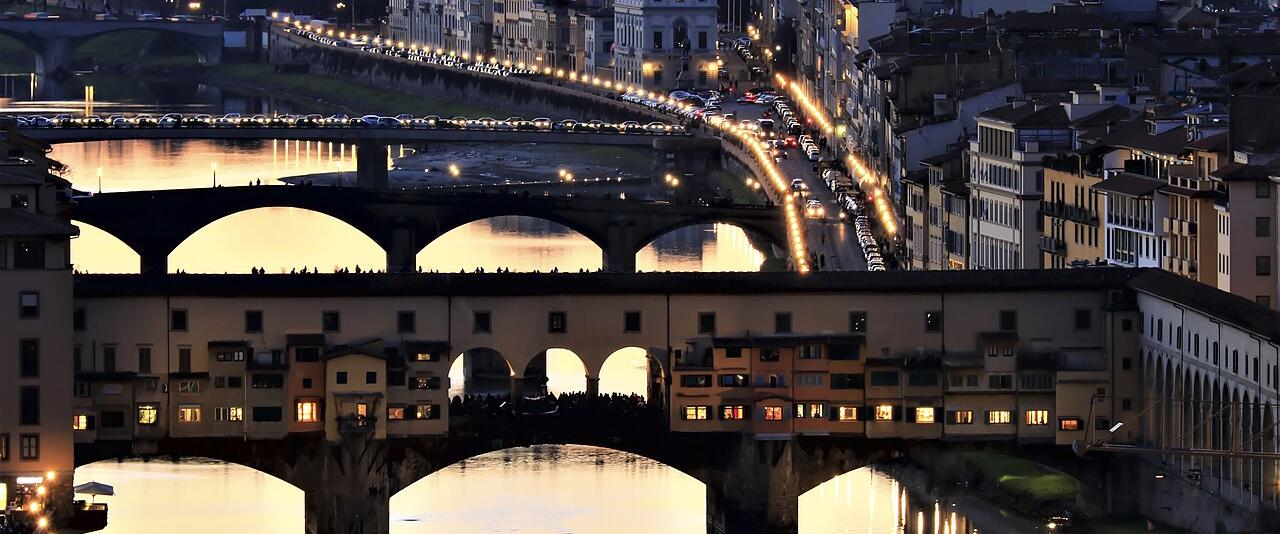
On the night of 3–4 August 1944, the retreating Germans blew up every bridge over the Arno except the Ponte Vecchio. Why they spared it is still argued over; a plaque on the bridge thanks the German consul Gerhard Wolf. After the war, the Ponte Santa Trinita was rebuilt exactly as it had been, using stones fished out of the river. Its four statues of the seasons were recovered too, except for the head of Spring, which was found in the Arno only in 1961.
 The Ponte Vecchio in August 1944, spared while the buildings at both ends were blown up. Image: Tanner (Capt), War Office official photographer, Public domain, via Wikimedia Commons.
Meanwhile Florence's art had been hidden in country villas. Allied officers, the "Monuments Men" among them Frederick Hartt, tracked it down, and the Italian agent Rodolfo Siviero spent decades bringing back works the Germans had taken.
 Spring, by Pietro Francavilla, on the Ponte Santa Trinita; her head was recovered from the Arno in 1961. Image: Francesco Bini, CC BY-SA 4.0, via Wikimedia Commons.
Where to see it today:
- The Ponte Vecchio and the Ponte Santa Trinita, where Spring stands again with her head restored.
- The Casa Museo Rodolfo Siviero, Lungarno Serristori 1–3, free, open on weekends and Mondays.
- The Museo del Ciclismo Gino Bartali in Ponte a Ema, just outside the city.
1950: The Leather School
In 1950, the Franciscan friars of Santa Croce and a Florentine leather craftsman founded a school in the friars' old dormitory to teach a trade to boys orphaned by the war. The Scuola del Cuoio is still there, still teaching, and now offers scholarships to young people at risk and to women who have survived violence.
Where to see it today: the Scuola del Cuoio, beside the basilica of Santa Croce.
4 November 1966: The Mud Angels
After days of rain, on the morning of 4 November 1966 the Arno broke its banks. Water rose to more than six metres in Santa Croce, and 35 people died in the province. About 14,000 works of art and millions of books and documents were damaged; at the National Library alone, more than a million items were soaked in mud and fuel oil. Cimabue's great Crucifix in Santa Croce lost most of its paint.
 Young volunteers, the "angeli del fango", in November 1966. Image: Francesco Memoli, Public domain, via Wikimedia Commons.
Within days, thousands of young people arrived from all over Italy and the world, unpaid, to dig books and paintings out of the mud, wash them and carry them to safety. The press called them the angeli del fango, the mud angels. The restoration that followed made Florence a world centre for conservation, and the National Library's restoration laboratory is still working on flood-damaged volumes today.
 Manuscripts from the National Library being washed after the flood. Image: Dominique Roger / Adam Cuerden, CC BY-SA 3.0 igo, via Wikimedia Commons.
Where to see it today:
- Look for the flood plaques that mark the water's height, on Via San Remigio, in Piazza Santa Croce and on the façade of the Misericordia.
- Cimabue's restored Crucifix hangs in the sacristy of Santa Croce, raised high above the floor.
- The National Library, by Santa Croce on Piazza dei Cavalleggeri.
 Cimabue's Crucifix, restored after the 1966 flood, in Santa Croce. Image: sailko, CC BY-SA 3.0, via Wikimedia Commons.
How to See Bright Florence
A self-guided walk, about 4 km. Start at the Innocenti on Piazza della Santissima Annunziata, then walk to Piazza del Duomo for the Misericordia and the dome. Continue to the Bargello for the competition panels and its courtyard, then to Santa Croce for Cimabue's Crucifix, the flood plaques and the Scuola del Cuoio. Walk along the river to the Museo Galileo, cross the Ponte Vecchio, and finish at the Ponte Santa Trinita with Spring. On the way, count the wine windows.
Further afield:
- Palazzo Pitti, where opera was born, and La Specola nearby.
- Piazzale Michelangelo at sunset.
- The English Cemetery and Casa Guidi.
- The Accademia della Crusca at Castello, and the Bartali museum at Ponte a Ema.
Dates to know:
- 18 February: the procession for Anna Maria Luisa de' Medici, with free civic museums.
- 4 November: the anniversary of the 1966 flood.
- 30 November: the Festa della Toscana, marking the abolition of the death penalty.