Why Ferrara is different
Ferrara, in Emilia-Romagna between Bologna and the Po river, was ruled by the Este family from the 13th century until 1598. Under them it became one of the main courts of Renaissance Italy, home to painters such as Cosmè Tura and Francesco del Cossa and to the poets Ludovico Ariosto and Torquato Tasso.
What sets the city apart is its plan. In 1492 Duke Ercole I d'Este commissioned the architect Biagio Rossetti to more than double the size of the city with a new, planned district to the north, the Addizione Erculea. Its straight, wide streets and long perspectives are often described as the first modern town plan in Europe. That is the main reason UNESCO listed Ferrara as a "City of the Renaissance" in 1995, extending the site in 1999 to include the Este villas and landscape of the Po Delta.
Castello Estense and the old centre
The moated Castello Estense stands at the hinge between the medieval town and Rossetti's extension. It was begun in 1385 as a fortress after a revolt against the Este, and gradually turned into a palace. Visits take in the frescoed ducal apartments, the prisons in the towers, and the walkway with views over the rooftops.
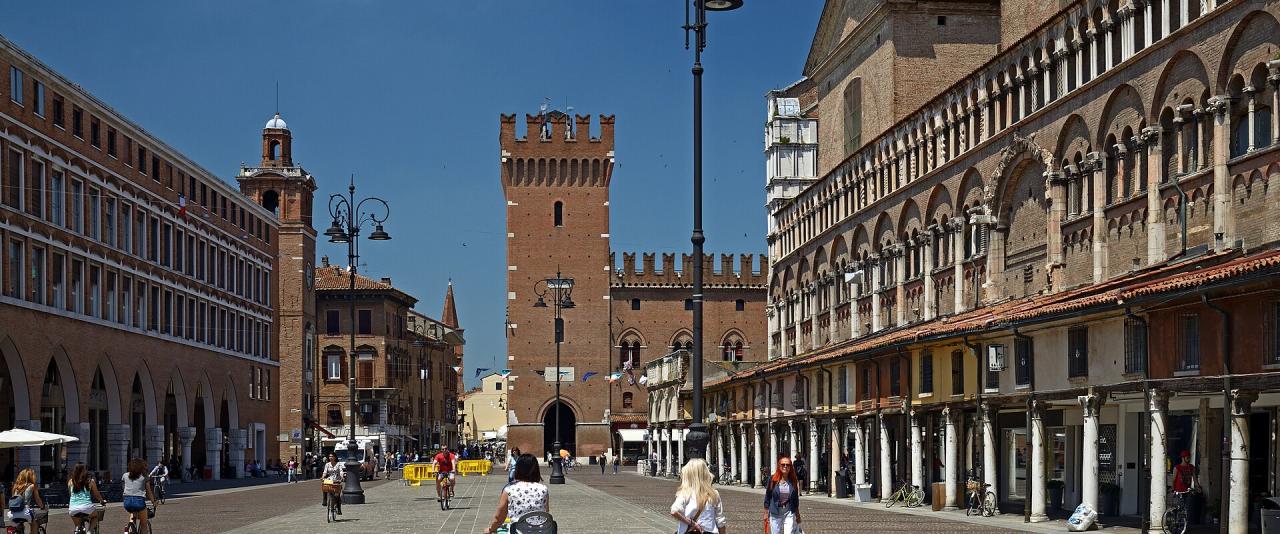
South of the castle lies the medieval city, with its narrow lanes, covered passages and the long Via delle Volte, a street of overhead arches that once connected merchants' houses to warehouses near the river. The Cathedral of San Giorgio, consecrated in the 12th century, has a Romanesque and Gothic façade facing the Piazza Trento e Trieste. Its museum, across the square, holds the organ shutters painted by Cosmè Tura and sculpture by Jacopo della Quercia.
The Addizione Erculea and Palazzo dei Diamanti
Walk north from the castle along Corso Ercole I d'Este and the city changes character: wide streets, gardens behind walls and long views. At the main crossroads, the Quadrivio degli Angeli, stands Palazzo dei Diamanti, whose façade is covered with around 8,500 marble blocks cut into diamond points. It houses the National Picture Gallery and hosts major temporary exhibitions, which are often the main reason people come to Ferrara for a day.
Nearby, Ariosto's house (Casa di Ludovico Ariosto) and the quiet Piazza Ariostea, laid out as part of Rossetti's plan, show how the district was meant to work as a whole.
Palazzo Schifanoia and the Hall of the Months
Palazzo Schifanoia, a pleasure palace of the Este family on the eastern side of the city, contains the Salone dei Mesi, a cycle of frescoes painted around 1470 for Duke Borso d'Este. Each month is shown on three levels: the gods of classical mythology above, signs of the zodiac and their astrological figures in the middle, and scenes of court life and farming below. Not all of the cycle survives, but what remains is one of the most important secular fresco programmes of the 15th century. The palace was closed for several years for restoration after the 2012 Emilia earthquakes, so check current opening times before you go.
Walls, bikes and the Jewish quarter
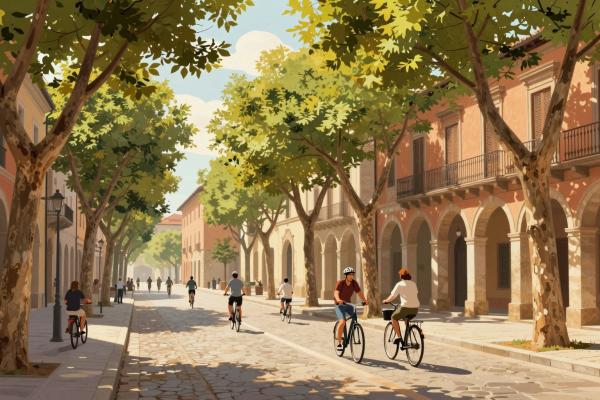
Ferrara is surrounded by an almost complete ring of Renaissance walls, about 9 km long. The top of the walls is a tree-lined path used by walkers, runners and cyclists, and a full loop is the best way to understand the size of the city. Ferrara is one of Italy's most bicycle-friendly cities: the centre is flat, and renting a bike for a few hours is easy.
The former Jewish ghetto, around Via Mazzini and Via Vignatagliata, was home to one of Italy's long-established Jewish communities and is the setting of Giorgio Bassani's novel The Garden of the Finzi-Continis. The National Museum of Italian Judaism and the Shoah (MEIS), housed in a former prison on Via Piangipane, tells the story of Jews in Italy over more than two thousand years.
Food to try
Ferrara has its own culinary traditions. Look for cappellacci di zucca, pasta filled with pumpkin, often served with butter and sage or a meat ragù; salama da sugo, a spiced pork sausage cooked for hours and served with mashed potato; and the coppia ferrarese, a twisted bread with protected status. Pampepato, a dense chocolate and spice cake, is a Christmas speciality.
Getting there and planning your time
Ferrara is on the main railway line between Bologna and Venice. Fast trains reach it from Bologna in about half an hour, so it works as a day trip, though one night lets you see the walls and the quiet streets in the evening. The station is a short walk or bike ride west of the centre.
A sensible day covers the castle, the cathedral area and Via delle Volte in the morning, Palazzo dei Diamanti and the Addizione Erculea after lunch, and a ride on the walls late in the afternoon. With a second day, add Palazzo Schifanoia, MEIS and a trip towards the Po Delta. Check museum opening days before travelling, since many close on Mondays.