A volcanic island
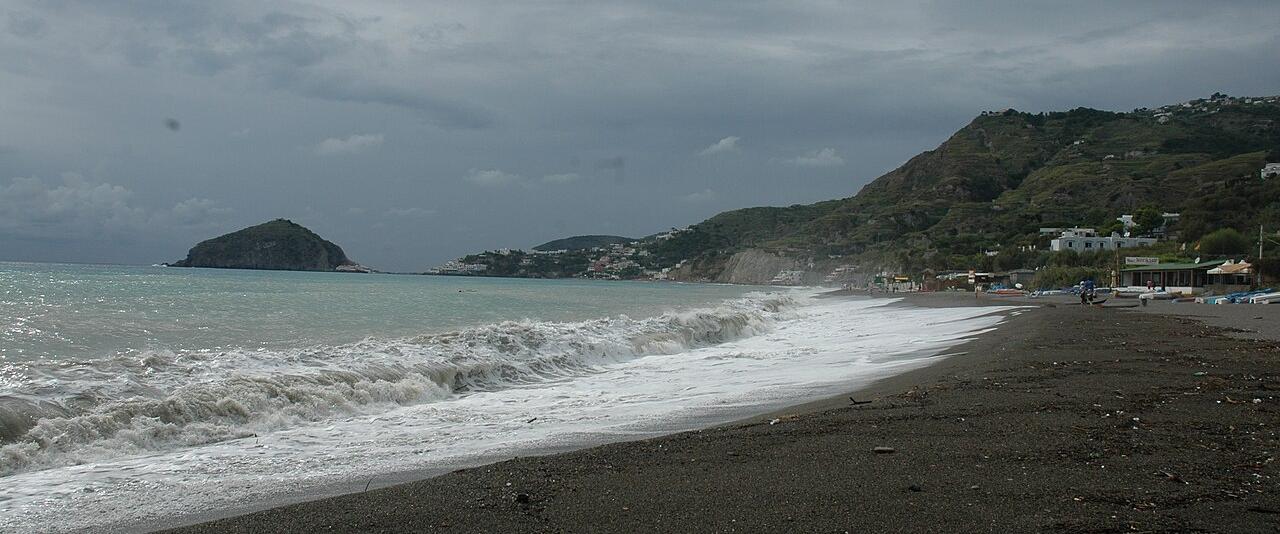
Ischia, the largest island in the Bay of Naples, is volcanic, and that shapes its beaches. The sand is generally dark: grey, brown or speckled rather than the jet black of islands like Stromboli. In several places hot water and steam rise along the shore, the same geothermal activity that feeds the island's thermal spas.
Much of the coastline is rocky, with beaches concentrated in coves and bays. Some are free public beaches (spiaggia libera), while long stretches are run as bathing establishments (stabilimenti) that rent sunbeds and umbrellas. In summer the more accessible beaches fill up, so arriving early or going by boat makes a difference.
Maronti
The Spiaggia dei Maronti, on the south coast below the village of Barano, is the island's longest beach, a curve of dark volcanic sand running for roughly 3 km. Steam vents (fumaroles) emerge in places along the beach, and at its western end a path leads into the gorge of Cavascura, where hot springs have been used for bathing since Roman times.
Maronti can be reached by road from Barano, with buses and a steep descent at the end, but the easiest approach is by water taxi from Sant'Angelo, the small, car-free fishing village at its western end. Large sections of the beach are free, and there are also bathing establishments. The sand near the fumaroles can be very hot, so wear sandals.
Sorgeto
The Baia di Sorgeto, below Panza in the municipality of Forio on the southwest coast, is a small rocky cove where hot springs flow into the sea. The water in the natural pools between the rocks is warm all year, and visibly hotter where the springs emerge, while the open sea beyond is much cooler. Swimmers move between them to find a comfortable temperature.
Sorgeto is reached by a long flight of steps down from the road, or by water taxi from Sant'Angelo. It is not a sandy beach, so water shoes help on the rocks, and it is at its best in the cooler months or in the evening, when the contrast between hot and cold water is most noticeable. Take care near the hottest vents, and stay out of the water in rough seas.
Citara and the west coast
Citara, south of Forio, is a sandy bay facing west, with views of the sunset. Much of it is taken up by bathing establishments and by a large thermal park built around the bay's hot springs. The rest of the west coast around Forio has smaller beaches and rocky platforms for swimming. In Forio itself, the Chiesa del Soccorso, a whitewashed church on a headland above the sea, is a good place to end the day.
San Montano and the north coast
The Baia di San Montano, at Lacco Ameno on the northwest corner of the island, is a sheltered bay with fine light sand and calm, shallow water, which makes it a popular choice for families. A thermal park overlooks the bay. Further east, the beaches of Casamicciola and Ischia Porto are close to the ferry ports and easy to reach without a car. The Spiaggia dei Pescatori in Ischia Ponte, with fishing boats pulled up on the sand, has a view of the Aragonese Castle.
Cartaromana
The Baia di Cartaromana, just south of the Aragonese Castle on the east coast, is a small bay with clear water, rocks and hot springs bubbling up near the shore. Remains of the Roman settlement of Aenaria, now underwater, lie in the bay. It can be reached on foot by a path from Ischia Ponte or by boat, and the view of the castle from the water is one of the best on the island.
Practical tips
- Getting there. Ferries and hydrofoils run from Naples and Pozzuoli to Ischia Porto, Casamicciola and Forio. Schedules vary by season, so check with the operators.
- On the island. Local buses circle the island and serve most beach areas, but can be crowded in summer. Water taxis from Sant'Angelo serve Maronti and Sorgeto in season.
- When to go. July and August are busiest. June and September usually offer warm sea and fewer people, and the hot springs at Sorgeto and Cartaromana can be enjoyed outside summer too.
- Free or paid. Free sections fill early in summer; for a sunbed and umbrella, expect to pay at a stabilimento and, in August, consider booking.
- Safety. Ischia has experienced natural hazards, including the 2017 earthquake at Casamicciola and the landslide there in November 2022. Follow local signs, as some paths and coastal areas may be closed for safety.