What to expect
Rome does not do Christmas the way Vienna or Nuremberg do, with a dozen large markets and mulled wine on every square. The season here centres on churches, nativity scenes and family meals, with one well-known market at Piazza Navona and a lot of lights on the main shopping streets. If you come expecting that, December is a good time to visit: the weather is mild by northern European standards, though often rainy, and outside the holiday days themselves many sights are quieter than in spring or autumn.
The holiday season runs from 8 December, the Feast of the Immaculate Conception, to 6 January, Epiphany. Both are public holidays in Italy, as are 25 and 26 December.
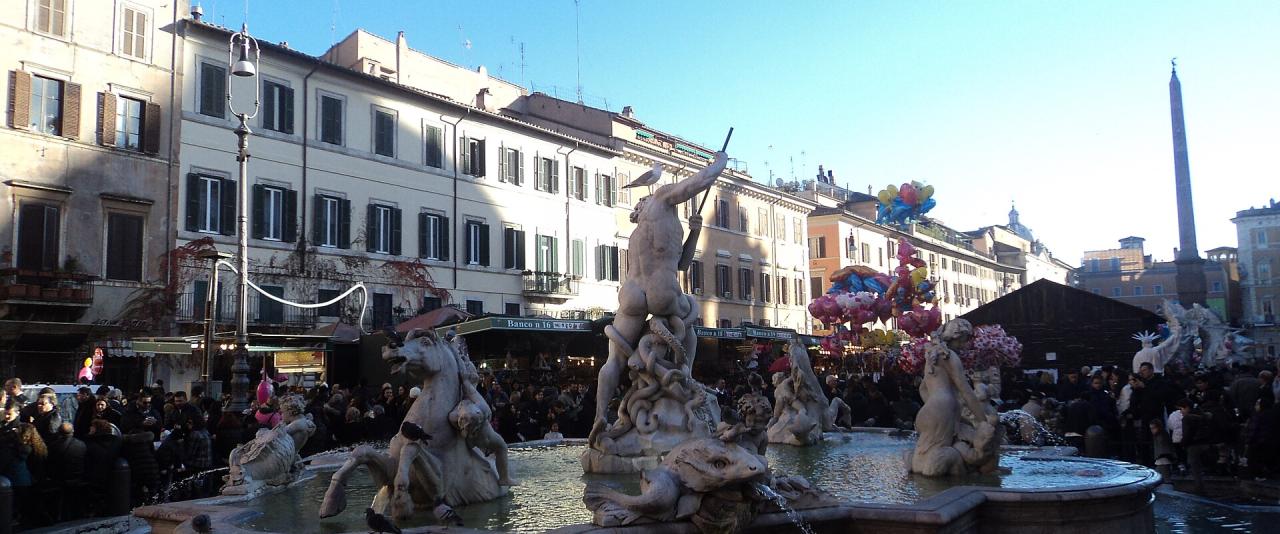
The Christmas market in Piazza Navona is Rome's best-known. In 2025 it opened on 6 December and ran until Epiphany on 6 January; the city announces each year's dates late, so check before you plan around it. The stalls spread around the long oval of the square and Bernini's Fountain of the Four Rivers, selling Christmas decorations, nativity figures, toys and sweets.
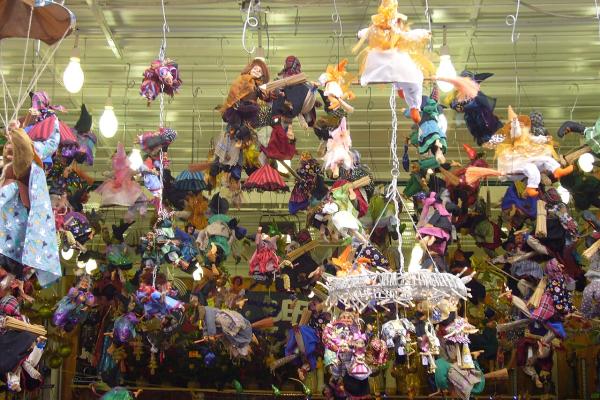
It is linked to the tradition of the Befana, the old woman who, according to Italian folklore, brings presents to children on the night before Epiphany, and figures of the Befana are everywhere. Opening dates and the layout vary from year to year, so check the city's official tourism website, turismoroma.it, for the current season. Other smaller seasonal markets and Christmas villages appear around the city; their dates and locations also change annually.
Nativity scenes (presepi)
Nativity scenes are the heart of Christmas in Rome, and seeing several is one of the best ways to spend a December day. Many churches set up a presepe from early December, some of them large and elaborate.
- Santa Maria in Aracoeli, at the top of a long flight of steps beside the Capitoline Hill, is associated with the Santo Bambino, a figure of the infant Jesus long venerated in Rome. At Christmas the church displays its nativity scene and the Bambino holds a central place in the celebrations.
- St Peter's Square has a large nativity scene and Christmas tree, unveiled in early or mid-December and kept up until the Baptism of the Lord in January. Each year the scene and the tree are donated by a different region or country.
- The "100 Presepi" exhibition, held under the colonnade of St Peter's Square in 2024 and 2025, brings together nativity scenes from Italy and abroad, from traditional Neapolitan scenes to modern designs. Check whether it returns for 2026.
Many smaller parish churches set up their own scenes too, and walking between them is a good way to see parts of the centre.
Christmas at the Vatican
The Pope celebrates Christmas Eve Mass in St Peter's Basilica, and on Christmas Day at noon gives the Urbi et Orbi ("to the city and the world") blessing from the central balcony of the basilica. The blessing is attended by large crowds in St Peter's Square and requires no ticket, though you need to arrive early and pass security checks.
Attending Christmas Eve Mass inside the basilica requires free tickets issued in advance by the Prefecture of the Papal Household, with requests made months ahead and no guarantee of a place. Check the official Vatican websites for the current procedure and times.
2025 was a Jubilee year, which brought record crowds and opened the Holy Doors of the papal basilicas. The Jubilee closed on 6 January 2026, so Christmas 2026 will be a normal year in Rome, without the extra pilgrim events.
What's open over the holidays
Most shops and many restaurants close on 25 December, and some also on 26 December, so book a table for Christmas Day lunch well in advance if you plan to eat out. Public transport runs a reduced service on Christmas Day. The Vatican Museums close on 25 and 26 December, and state museums have their own holiday closures. On 31 December, bars and restaurants are busy, and New Year's Eve is often marked with a large public concert in the city; check the city's events calendar for details.
On other December days most sights operate normally, though often with shorter winter hours, so plan visits for the morning and early afternoon.
Practical tips
- Book accommodation early for the Immaculate Conception weekend, Christmas and New Year, when Italian visitors also travel to Rome.
- Pack for rain. December is one of Rome's wettest months, and an umbrella and waterproof shoes are useful on the cobblestones.
- Use the late afternoon. The lights on Via del Corso, Via Condotti and around the Spanish Steps come on as it gets dark, and that is the best time to walk through the centre.
- Try seasonal food. Panettone and pandoro are everywhere in December, and Roman families often eat fish on Christmas Eve.