Italy's festive season runs from the Immacolata on 8 December to the Befana on 6 January, and on the way it has four public holidays: Christmas Day (25 December), Santo Stefano (26 December), New Year's Day (1 January) and Epiphany (6 January). In 2026 the Immacolata falls on a Tuesday. On New Year's Eve, Thursday 31 December 2026, Italians eat lentils and cotechino, wear red underwear for luck and, until each city's rules say otherwise, let off fireworks at midnight. This guide covers the dates, the food, what to know about the fireworks bans that many Italian cities impose, and how the Befana ends the season.
Most city programmes for New Year's Eve are published in December. Where something is not confirmed, this guide says so.
Capodanno food: lentils, cotechino and panettone
New Year's Eve dinner (the cenone) usually ends with lenticchie (lentils), eaten at midnight or on 1 January because their round shape is said to bring money, and cotechino or zampone, spiced pork sausage and stuffed pig's trotter that are traditionally served with them. At the end of the meal comes panettone (the tall, domed fruit bread from Milan) or pandoro, the plain golden loaf from Verona.
 Cotechino with lentils, the New Year dish. Image: Andrea Tosatto from Torino, Italia, CC BY 2.0, via Wikimedia Commons.
Italians also wear something red on New Year's Eve, often underwear, which is believed to bring luck and love in the new year.
Fireworks: check the city's rules
Fireworks at midnight are a New Year's custom, but many Italian cities restrict them by mayoral order, and the rules change each year. At the last New Year, for example:
- Rome banned fireworks and explosives from 00:01 on 31 December 2025 to midnight on 6 January 2026.
- Milan, Florence, Catania, Ravenna and Palermo banned them for the night. Palermo's fines were reported as €500 to €5,000.
- Some towns allowed a short window: Imperia allowed fireworks only between midnight and 01:00.
The orders for 2026/27 are not out yet. Each comune publishes its own on its official notice board in the last days of December, so check the city you are staying in. Do not buy fireworks as a visitor; the fines are real.
New Year's Eve in the big cities
Rome held a free concert at the Circus Maximus on 31 December last year. Its 2026 programme has not been announced. Elsewhere the main squares host concerts and DJ sets, and some city centres limit entry or ban glass containers; the rules are posted by the comune a few days before. Most people celebrate with family or friends at dinner and head to the square around 23:30.
Christmas: from the Immacolata to Santo Stefano
On 8 December, the Feast of the Immacolata (Immaculate Conception), it is a public holiday, many shops stay open, and many people put up the tree and the crib that day. 24 December is the vigilia, a meat-free dinner of fish in many families, and 25 December is a long lunch with family. 26 December, Santo Stefano, is also a public holiday, when the family meal continues or people visit relatives.
 A panettone, the Milan Christmas cake. Image: N i c o l a from Fiumicino (Rome), Italy, CC BY 2.0, via Wikimedia Commons.
The Befana: 5 and 6 January
The Befana is an old woman on a broomstick who, in Italian tradition, brings sweets to good children and coal (today usually coal-shaped sugar) to naughty ones in the night between 5 and 6 January. 6 January is a public holiday, and the day ends the festive season: the Italian saying is that "l'Epifania tutte le feste porta via", meaning the Epiphany takes all the holidays away.
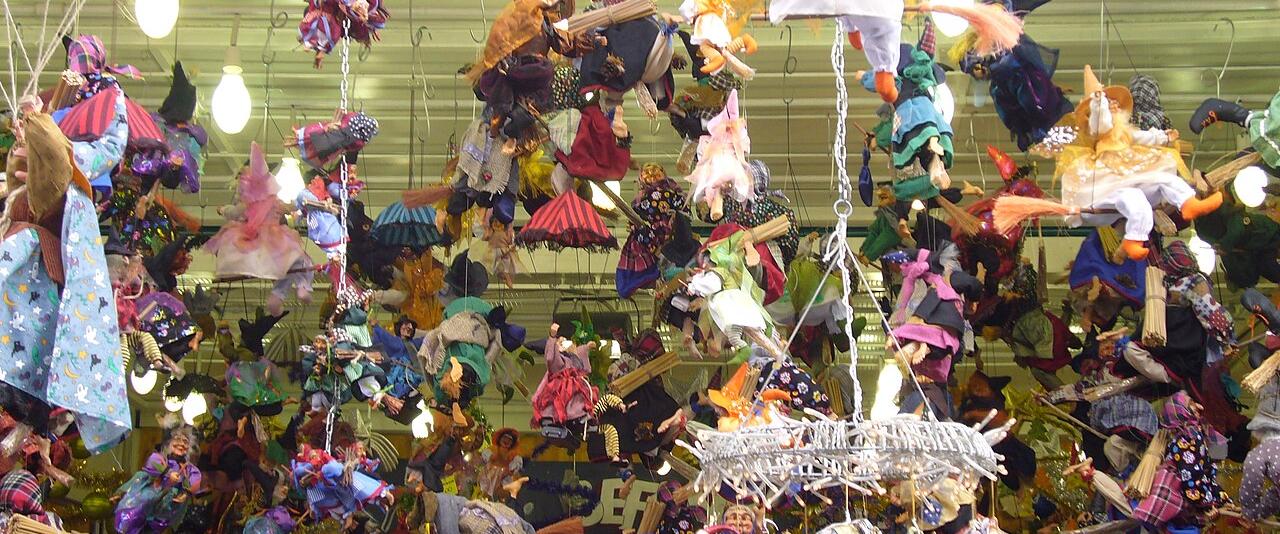
 Befana dolls hanging at a Christmas stall in Piazza Navona, Rome. Image: Lalupa, CC BY-SA 3.0, via Wikimedia Commons.
Many places hold their own Befana event: in Venice the rowers of the Regata della Befana dress up as Befana on the Grand Canal, and Rome's Piazza Navona has traditionally had a Christmas fair with stalls selling Befana dolls.
 Rowers dressed as the Befana in Venice on 6 January 2025. Image: LODlibrarian, CC BY-SA 4.0, via Wikimedia Commons.
What's open
On 25 December, 1 January and 6 January, most shops and many restaurants are closed, and museums and monuments are often closed on 25 December and 1 January. Hours on 26 December and on 24 and 31 December vary, and public transport runs a reduced timetable. Check each site before you go.
Tips
- Book the cenone early: restaurant dinners on 31 December are usually fixed-price menus, and the best fill up weeks ahead.
- Do not plan on fireworks: many cities ban them; if there is an organised display, it will be announced.
- Keep 6 January free: shops and museums are closed, so use it for a Befana event or a long lunch.