Via San Gregorio Armeno, the "street of the nativity scenes" in Naples' historic centre, is open all year, but its Christmas season runs from early November to 6 January, when the workshops put out their fullest displays of presepe figures. There is no ticket, no fixed opening hour and no single market: it is a narrow lane of family workshops and shops, a short walk from the Duomo stop on metro Line 1 in Piazza Nicola Amore. Italy's national tourism site calls it "the heart of Naples and its traditions", and in December it is one of the most crowded streets in the city.
This guide covers the street's history, what you can buy, how to avoid the worst of the crowds, and the other nativity scenes in and around Naples that are worth the trip: the Cuciniello presepe at the San Martino museum, the Banco di Napoli nativity scene in the Royal Palace, and the royal crib at Caserta.
What is Via San Gregorio Armeno?
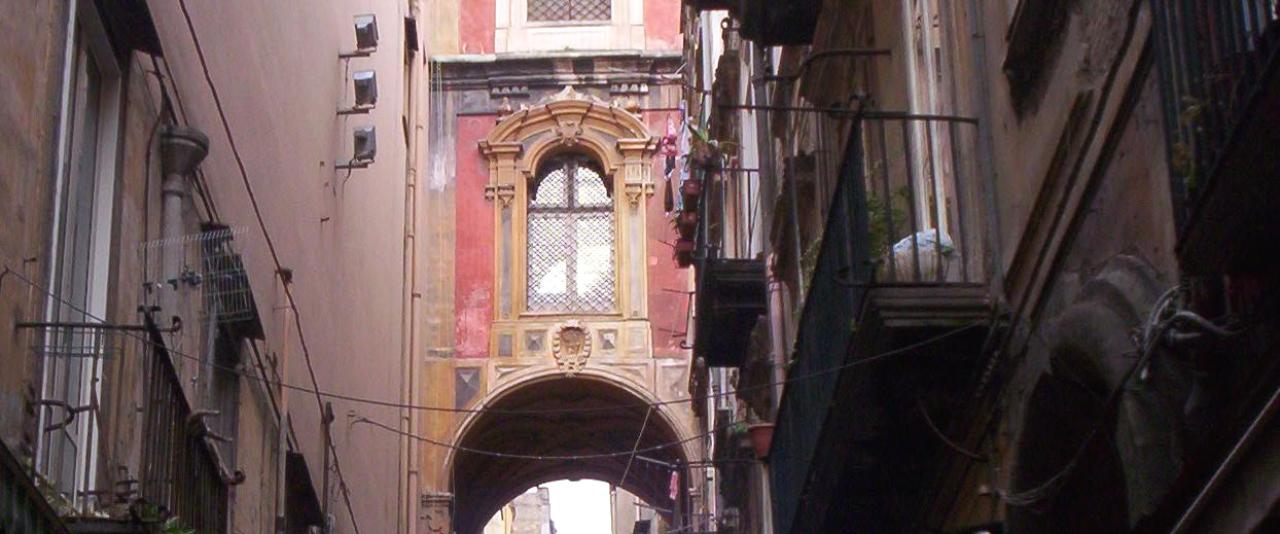
San Gregorio Armeno is a steep, narrow lane that runs through the old Greek and Roman street grid of Naples, between Via San Biagio dei Librai (part of the long straight street known as Spaccanapoli) and Via dei Tribunali. The whole historic centre is a UNESCO World Heritage Site. The street takes its name from the church and convent of San Gregorio Armeno, whose bell tower crosses the lane on an arch, the landmark that most photographs of the street are framed around.
 Workshops on Via San Gregorio Armeno, with the convent's bell tower bridging the lane. Image: Luca Aless, CC BY-SA 4.0, via Wikimedia Commons.
Almost every ground floor on the street is a workshop or shop selling figures and scenery for the presepe, the Neapolitan nativity scene. Some make and finish figures by hand on the premises; others mainly sell. The shops are open all year, and Italia.it puts it simply: it is always Christmas on this street.
A short history of the street of nativity scenes
According to Italia.it, the street was once a Roman road where a Temple of Ceres, the goddess of fertility, stood. Worshippers brought small terracotta statues as offerings, and the first craft shops grew up to make them. The tradition of handmade nativity figures became popular much later, around the eighteenth century, which is why the classic Neapolitan presepe still dresses its shepherds, traders and townsfolk in eighteenth-century clothes.
 Stalls of figures and toys on Via Toledo on Christmas Eve, in an engraving by Edoardo Matania published in 1886. Image: Edoardo Matania, Public domain, via Wikimedia Commons.
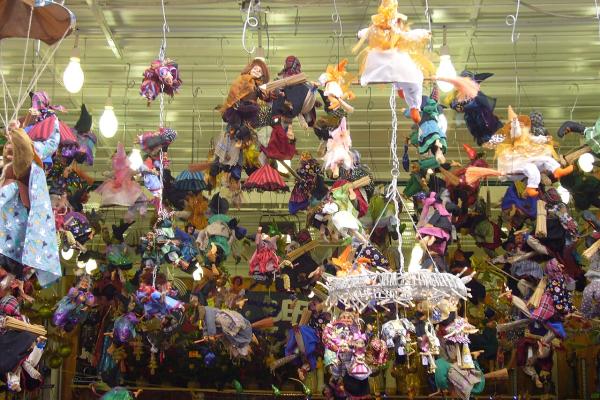
A Neapolitan nativity scene is more than the stable. The Holy Family sits in a small corner of a crowded scene of taverns, market stalls, musicians and street life, a mix of the sacred and the everyday that the tourism board describes as having "a good dose of theatrical irony". That spirit carries on in the topical figures sold next to the shepherds: footballers, politicians, singers and other public figures, modelled each year on whoever has been in the news. In recent seasons the shops have sold figures of tennis player Jannik Sinner and Donald Trump.
What to buy on San Gregorio Armeno
The street sells everything needed to build a presepe, from figures about 3 centimetres tall to much larger pieces:
- Pastori: the figures themselves, from simple terracotta shepherds to figures dressed in cloth costumes in the traditional eighteenth-century style.
- Miniature food and goods: tiny loaves, fish, fruit baskets, cheeses and cured meats for the market scenes.
- Scenery: grottoes, ruined temples, taverns, fountains and houses, some with working lights, flowing water and moving parts.
- Topical figures: the current year's celebrities and politicians, usually displayed at the front of the shop.
Prices vary a great deal between a mass-produced resin figure and a hand-finished terracotta piece by a known workshop. If you want something made locally, ask whether it was made in the shop, and look for workshops where you can see figures being finished.
 Shoppers and window displays on Via San Gregorio Armeno. Image: Photo2023, CC BY 4.0, via Wikimedia Commons.
When to go and how to avoid the crowds
The workshops are open all year, so if you want to buy without the crush, come in October or early November, before the Christmas displays fill the street. From November to early January the lane is at its busiest, and on December weekends and holidays (8 December, the Immaculate Conception, is a national holiday) the flow of people can slow to a shuffle along the whole street.
A few tips:
- Come early on a weekday. Mornings are quieter than afternoons, when tour groups and day-trippers arrive.
- Watch your bag. The lane is narrow and packed, conditions pickpockets like.
- Don't block the street to photograph. Step into a shop doorway or a side alley to take pictures.
The church and cloister of San Gregorio Armeno
Halfway down the street is the Church of San Gregorio Armeno, also known as Santa Patrizia, one of the most important churches in Naples. Its convent was rebuilt in the late sixteenth century to designs by Giovanni Francesco Mormando and Giovanni Battista Cavagna, and the church took on its present Rococo look in the eighteenth century. Inside are a coffered ceiling by the Flemish painter Teodoro d'Errico and frescoes by Luca Giordano, including the Glory of San Gregorio.
 The entrance of the Church of San Gregorio Armeno, on the street that takes its name. Image: Armando Mancini, CC BY-SA 2.0, via Wikimedia Commons.
The church keeps relics of Saint Gregory the Illuminator, the Armenian saint it is named after, and the body of Saint Patricia, one of the patron saints of Naples, which makes it a place of pilgrimage. From the church you can reach the convent's cloister, with a Baroque marble fountain and statues of Christ and the Samaritan woman, a quiet garden after the noise of the street. Opening times for the church and cloister are limited and change, so check locally on the day.
 The cloister of the convent of San Gregorio Armeno, with its Baroque marble fountain. Image: Diego Delso, CC BY-SA 4.0, via Wikimedia Commons.
The Cuciniello presepe at the San Martino museum
To see what the eighteenth-century figures on sale below are imitating, go up to the Vomero hill and the Certosa e Museo di San Martino, the former Carthusian monastery that houses the National Museum of San Martino. Its best-known exhibit is the Presepe Cuciniello, which Italia.it describes as made up of about 800 pieces and the most famous and important nativity scene in Naples.
 The Presepe Cuciniello at the San Martino museum, with the Nativity set among ruins, crowds and the angels above. Image: Sailko, CC BY 3.0, via Wikimedia Commons.
The figures were collected by Michele Cuciniello, a Neapolitan who lived in the second half of the nineteenth century. He collected eighteenth-century shepherds and also arranged the scene himself, in the layout visitors still see, before donating the collection to the city. The scene shows the Nativity, the journey of the Magi and a busy tavern, with figures of every class and trade.
 Eighteenth-century figures in the Cuciniello presepe, dressed in the clothes of the period. Image: Miguel Hermoso Cuesta, CC BY-SA 4.0, via Wikimedia Commons.
Practical info: Certosa e Museo di San Martino, Largo San Martino, Vomero. Italia.it lists the museum as opening at 8:30 and closed on Wednesdays, with an afternoon closing time that changes by day and season, so check the museum's page on cultura.gov.it before going. The quickest way up from the historic centre is one of the funiculars to Vomero, then a short walk.
 The great cloister of the Certosa di San Martino in December. Image: Tremej, CC BY-SA 4.0, via Wikimedia Commons.
Other nativity scenes in and around Naples
- The Banco di Napoli nativity scene, Palazzo Reale. A short walk from Piazza del Plebiscito, the Royal Palace shows a large presepe of more than 300 original eighteenth-century figures of shepherds, animals and religious figures, by sculptors including Giuseppe Sanmartino, Angelo Viva and Salvatore Di Franco.
- The royal crib, Reggia di Caserta. The piano nobile of the Bourbon palace at Caserta, under an hour from Naples by train, holds a large eighteenth-century Neapolitan nativity scene, reconstructed on the model of one commissioned by Ferdinand II in 1844 and designed by the painter Giovanni Cobianchi. It is seen as part of the Royal Apartments visit.
- The underwater nativity scene, Grotta dello Smeraldo. In the Emerald Grotto at Conca dei Marini on the Amalfi Coast, five fibreglass figures stand on the seabed about 4 metres down.
Italia.it also notes that the Comune di Napoli runs a calendar of theatre, music, dance, guided tours and craft markets in different parts of the city through the Christmas period.
Getting there
San Gregorio Armeno sits in the middle of the historic centre. The nearest metro stop is Duomo on Line 1, in Piazza Nicola Amore, about ten minutes' walk away. From Napoli Centrale station it is about 20 minutes on foot. Dante (Line 1) and Museo (Line 1) are also within walking distance. The street itself is pedestrian, so plan to arrive on foot.
Combining San Gregorio Armeno with a day in the centro storico
The street makes a good centre for a walking day. Start at the Duomo of Naples on Via Duomo, walk west along Via dei Tribunali, turn down San Gregorio Armeno, and continue along Spaccanapoli towards the Gesù Nuovo and Santa Chiara. In the afternoon take a funicular up to San Martino for the Cuciniello presepe and the view over the bay.
If you are spending Christmas elsewhere in Italy, our guide to Christmas in Rome covers Piazza Navona and the nativity scenes of the capital.