Cortina d'Ampezzo has about 120 km of slopes on its own local lift pass, with 66 runs and 26 lifts in the Cortina ski area itself, spread over four main sectors: the Tofane, Faloria–Cristallo, the Cinque Torri and the Lagazuoi at Passo Falzarego. The same mountains hosted the women's alpine races at the Milano Cortina 2026 Winter Olympics, and the Olimpia delle Tofane race course is an ordinary piste you can ski when it is not closed for racing. You can ski on a Cortina-only pass, or buy Dolomiti Superski, which adds the other eleven valleys of the Dolomites.
This guide covers each ski area, which pass to buy, where beginners should start, how to get to Cortina without a car, and what the Olympics changed.
Quick facts (checked October 2026)
- Local pass: the Valle skipass covers Cortina, San Vito di Cadore and Auronzo–Misurina, about 120 km of slopes.
- Regional pass: Dolomiti Superski covers 12 valleys and about 1,200 km of slopes.
- Season: the Tofana lifts ran from 5 December 2025 to 12 April 2026. The 2026–27 dates are announced by the lift companies in the autumn.
- No railway: the nearest stations are Calalzo di Cadore (35 km) and Dobbiaco (31 km), linked to Cortina by bus. Daily coaches run from Venice airport and Venice Mestre station.
- Prices: published each autumn on dolomitisuperski.com. Buying online up to two days ahead gives a 5% discount.
Which ski pass do you need for Cortina?
There are two choices.
The Valle skipass (Cortina d'Ampezzo). Valid on the whole Cortina area, including the Skyline gondola and the Lagazuoi down to Armentarola, plus San Vito di Cadore and Auronzo–Misurina: about 120 km of slopes. The tourism office says it is sold as day, multi-day and season passes, with reductions for juniors and over-65s and free skiing for accompanied children.
Dolomiti Superski. Valid in all 12 valleys of the Dolomiti Superski network, about 1,200 km of slopes, including Alta Badia, Val Gardena and the Sella Ronda. It also has reductions for children, juniors and seniors.
If you plan to stay in Cortina for the whole trip, the Valle pass is enough: 120 km is more than most people ski in a week. If you want to ski the Armentarola run into Alta Badia and carry on round the Sella, or spend a day in Val Gardena, buy Dolomiti Superski. For an overview of the wider network see our guide to skiing in the Dolomites.
How to buy. Online on the Dolomiti Superski website, with a 5% discount if you buy at least two days before the first day. You can load the pass onto a reusable My Dolomiti Card and go straight to the lifts, or collect a printed pass with a QR code from the ticket offices or the pick-up boxes around Cortina. The ticket offices at the lifts sell day passes and multi-day passes of up to seven days; longer passes and season passes are sold only at the central skipass office or online.
Prices. The 2026–27 prices were not yet listed when we checked. Dolomiti Superski publishes them on its website before the season, with the Valle pass prices alongside.
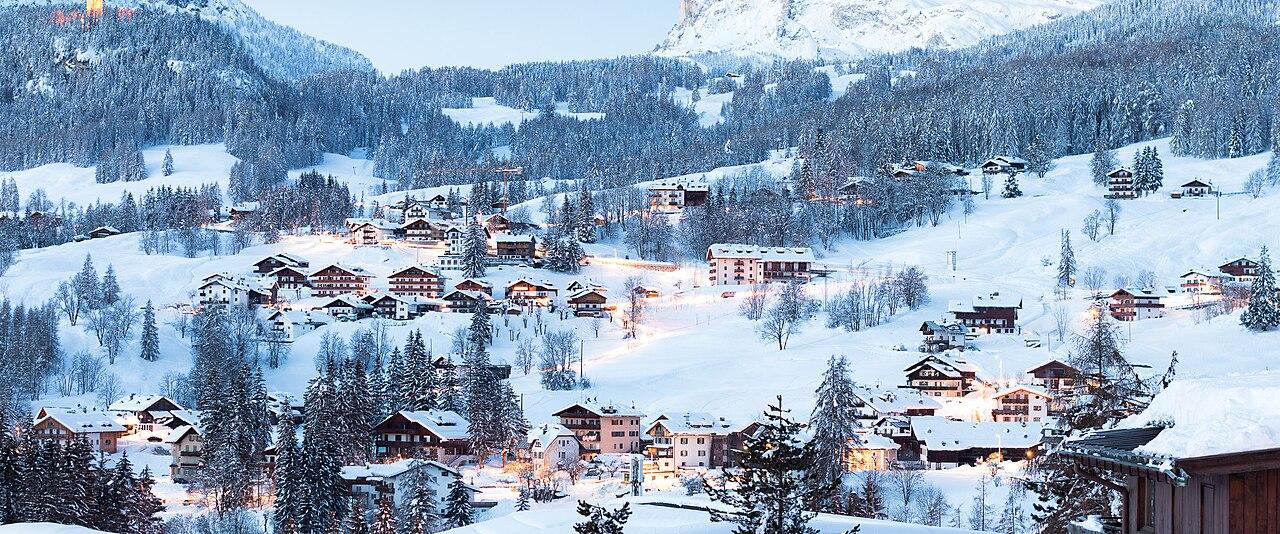
 Snow-covered slopes above Cortina, with the Ampezzo valley below. Image: Acquario51, CC BY-SA 4.0, via Wikimedia Commons.
The Tofane: Cortina's main ski area
The Tofane are the high mountains on the western side of the town, and the slopes below them are the largest part of Cortina's ski area. There are two ways up.
From the town centre: Col Drusciè and Ra Valles. The Tofana–Freccia nel Cielo lifts start near the Ice Stadium: a gondola to Col Drusciè, then a cable car to Ra Valles, at about 2,700 m, where the snow is natural and is groomed every night. A third cable car continues to Cima Tofana, but only opens in winter on special occasions, depending on the weather. The lift company describes Druscié A as its most technical run. It was the 1956 Olympic slalom course, won by Toni Sailer, and it was used again at the 2021 World Championships. Druscié B is an easier run through the woods, suitable for families. Forcella Rossa, which the company calls its most scenic run, descends among the Dolomite rocks. Stries is the only run in Cortina that takes you back to the town on skis. It starts from the gondola's middle station and follows the old bobsleigh run down to the Ice Stadium.
From Pocol and Socrepes: the Olympic side. The lower slopes below the Tofane, around Socrepes and Pocol, are served by the Tofana Express chairlift, the Piè Tofana–Duca d'Aosta and Duca d'Aosta–Pomedes chairlifts, the Olympia chairlift at Pocol and the Baby Socrepes chairlift. The Olimpia delle Tofane run is here.
 The Tofane above Cortina, with the Olimpia delle Tofane course and the Col Drusciè runs cut through the forest. Image: kallerna, CC BY-SA 4.0, via Wikimedia Commons.
The Olimpia delle Tofane: can you ski the Olympic run?
Yes. The Olimpia delle Tofane is the course for Cortina's women's World Cup races and was the women's alpine venue at the 2026 Olympics. The rest of the time it is a normal piste. Before the Games it was closed from 12 January 2026 to prepare it for racing, and it can close again for races and training. It is a race course, with the steep Tofana Schuss near the top, so it is for confident skiers. Check the open-runs list on the morning you plan to ski it.
 The Olimpia course on the Tofane during the 1956 Winter Olympics, Cortina's first Games. Image: Unknown authorUnknown author, Public domain, via Wikimedia Commons.
Cinque Torri and the Cortina Skyline
The Cinque Torri, five rock towers on the road to Passo Falzarego, are surrounded by a smaller ski area. Since the Cortina Skyline gondola opened, you can ski there from the Tofane. It runs from Son dei Prade near Pocol, through a middle station at Cianzopè, to Bai de Dones below the Cinque Torri, taking about 15 minutes. From the Cinque Torri, lifts and runs continue to Averau and Passo Falzarego, so you can ski from Cortina to the Lagazuoi without using a bus.
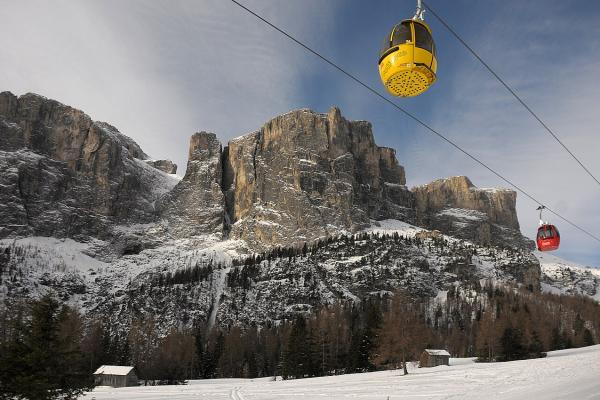
 The Lagazuoi, the Falzarego towers, the Tofana di Rozes and the Cinque Torri in winter. Image: This Photo was taken by Wolfgang Moroder. Feel free to use my photos, but please, CC BY-SA 3.0, via Wikimedia Commons.
The Lagazuoi and the Armentarola run
From Passo Falzarego a cable car climbs to about 2,730 m, just below the summit of the Lagazuoi. There are two runs down.
- The Lagazuoi run goes back to the pass: 2,470 m long with 635 m of descent. It is technical, with plenty of changes in gradient, and it crosses the First World War front line, past Austrian trenches on the saddle and Italian trenches lower down.
- The Armentarola run goes the other way, 8.5 km down to Ponte Sarè at 1,660 m in Alta Badia, through the Fanes–Senes–Braies nature park under the walls of Cima Scotoni. It is one of the best-known runs in the Dolomites, and a gentle one, best done without hurrying. At the bottom a horse-drawn tow pulls skiers along the flat to the Alta Badia lifts. The Valle pass covers the descent; you need Dolomiti Superski to carry on skiing in Alta Badia.
To get back to Cortina from Alta Badia there are ski buses and scheduled buses to Passo Falzarego. Check the winter road connections on the Lagazuoi website before you set off.
 The chapel at Passo Falzarego in winter, at the foot of the Lagazuoi cable car. Image: Rics1299, CC BY-SA 3.0, via Wikimedia Commons.
Faloria–Cristallo and the rest of the valley
On the other side of the valley, east of the town, the Faloria–Cristallo area faces the Tofane across the valley and is reached by cable car from the town. During the Olympics it stayed open while much of the Tofane area was closed. San Vito di Cadore, a few kilometres south, and Auronzo–Misurina to the east are included in the Valle pass and make good day trips when the main areas are busy.
Where should beginners ski in Cortina?
Start on the lower slopes at Socrepes, which have their own small Baby Socrepes chairlift, then move on to easy runs such as Druscié B, which the lift company recommends for families. Cortina has several ski schools, and the tourism office lists them on its guides-and-schools page; a few lessons are the quickest way to learn which runs suit you. On the Valle pass accompanied children ski free, which helps keep a family week affordable.
What did the 2026 Olympics leave behind?
The Games were held from 6 to 22 February 2026, with the Paralympics from 6 to 15 March. Cortina hosted the women's alpine skiing, curling and the sliding events, and the Paralympic alpine skiing, wheelchair curling and para-snowboard.
For skiers the main legacy should have been a new Apollonio–Socrepes gondola, linking the town to the Olimpia delle Tofane area, with three stations including a middle station at Mortisa. It was not finished in time for the Games, and reports in late March 2026 said it was still not carrying passengers. Before you plan around it, check the Cortina tourism office's open-lifts page to see whether it is running this winter.
How to get to Cortina without a car
Cortina has no railway station. These are the options listed by the tourism office:
- From Venice: daily coaches run by Cortina Express, Flixbus and ATVO from Venice Marco Polo airport (162 km) and Venice Mestre station. In high season there are also coaches from Treviso airport, Rovigo, Ferrara and Bologna. Coaches stop at the bus terminal by the Ice Stadium.
- By train and bus: take the train to Calalzo di Cadore (35 km), then a Dolomiti Bus to Cortina, or to Dobbiaco/Toblach in South Tyrol (31 km), then a SAD bus.
- Other airports: Treviso (130 km), Innsbruck (170 km) and Verona (260 km).
- By car: the A27 motorway ends at Belluno, 72 km south; from the north, leave the A22 at Bressanone/Brixen, 87 km away.
 Calalzo di Cadore station in snow, the railhead for buses to Cortina. Image: Bobspa, CC BY-SA 4.0, via Wikimedia Commons.
Tips for skiing in Cortina
- Plan the Armentarola day around the buses. Check the return times to Falzarego before you leave.
- Use the ski bus. The sectors are spread around the valley, and the ski bus links them with the centre.
- Buy online and load a My Dolomiti Card. It saves 5% and lets you go straight to the lifts.
- Check the open-lifts page each morning. Race closures, wind on the high cable cars and the status of the new Socrepes gondola all change what you can ski that day.
 Corso Italia, Cortina's main street, on a February afternoon. Image: MaiDireLollo, CC BY-SA 3.0, via Wikimedia Commons.