







- Where
- Gubbio, Umbria and Marche
- Directions
- Directions
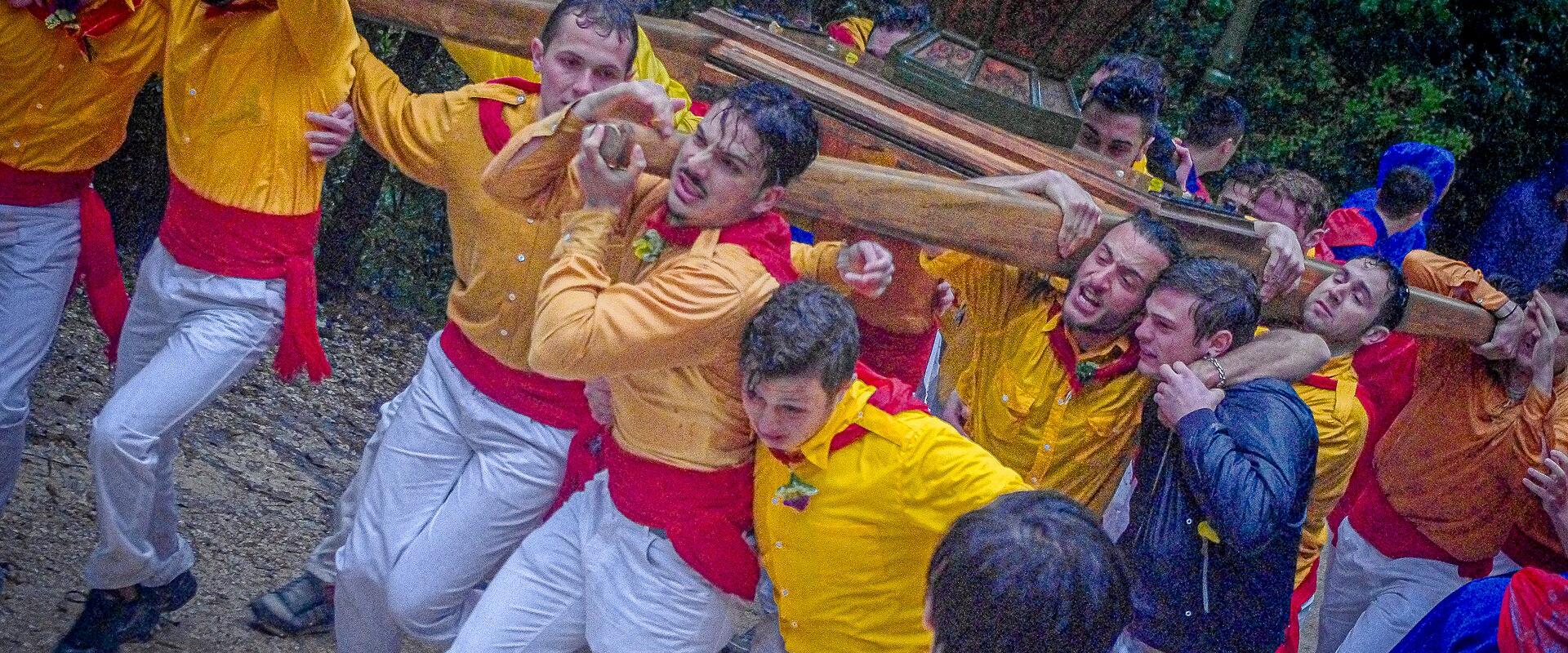
The Festa dei Ceri, the Festival of the Candles, is one of the oldest and most spectacular traditions in Italy, and it is held every year in Gubbio, in Umbria, on 15 May, in the Umbrian tradition, the eve of the feast of Saint Ubaldo, the town’s patron saint. The festival is recognised by UNESCO as part of the Intangible Cultural Heritage of Humanity, and it draws visitors from across Italy and the world to see a unique mix of devotion, history and extraordinary physical effort. The origins are medieval. Saint Ubaldo was bishop of Gubbio in the 12th century, and he died on 16 May 1160, and it is said that the festival began as a way to honour him and to thank him for protecting the town. In its present form, it is a celebration of the identity of Gubbio, and for the people of the town, called the Eugubini, it is the most important day of the year.
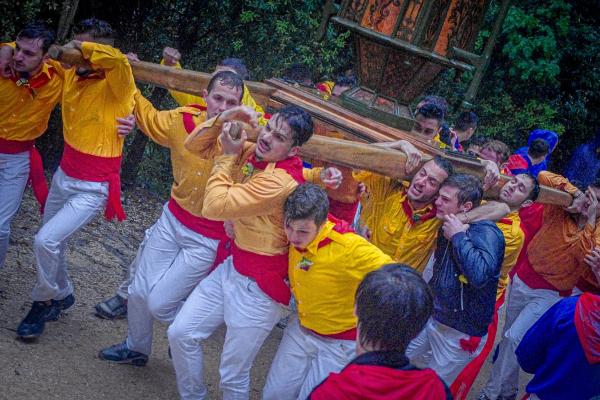
The festival centres on three huge wooden structures called ceri, a word that means candles, though they are not candles in the usual sense. Each cero is an octagonal prism of wood, about five metres high and weighing between two hundred and eighty and four hundred kilograms, and it is mounted on a wooden frame called a barella, a stretcher, that allows it to be carried on the shoulders of the bearers. On top of each cero is a statue of a saint. The first is Sant’Ubaldo, the patron saint, who is the saint of the masons and the first in the race, the second is San Giorgio, Saint George, who is the saint of the merchants, and the third is Sant’Antonio, Saint Anthony Abbot, who is the saint of the farmers and the students. Each saint has his team, wearing coloured shirts, yellow, blue and black, with red scarves.
The day begins early with processions, music and the Alzata, the raising of the ceri in the main square, Piazza Grande, when the three structures are lifted upright to the roar of the crowd, in a moment of high emotion. Later in the day, the great race takes place. Teams of twenty or more men, the ceraioli, hoist the ceri onto their shoulders and carry them at full speed, running through the narrow, cobbled, winding streets of the town, which are packed with spectators, before beginning the steep climb up Monte Ingino, to the Basilica of Sant’Ubaldo at the top, where the saint’s body lies. The order of the ceri is fixed, and they must stay in the same sequence, and the race is not about winning, but about the effort, the rhythm and the spirit of the celebration. The race ends at the basilica, where the ceri are shut inside.
The festival is a spectacle that fills the town, and it is extremely crowded, so anyone planning to attend should book accommodation well in advance and arrive early to find a place to watch. Details of the programme change from year to year, and the streets are closed to traffic, so check the schedule and be prepared for crowds. Outside the festival, the Museo dei Ceri displays the structures. Gubbio has other sights, among them the Basilica of San Francesco, the Palazzo dei Duchi, the Palazzo dei Consoli, the Museo Civico (Civic Museum) and the Cattedrale di San Giorgio. The festival suits anyone interested in living tradition and folklore.
Categories
More photos coming soon
Nearby Attractions
Other places to visit in Gubbio
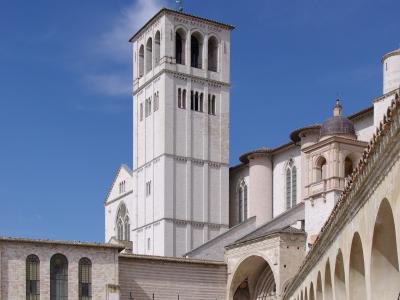
Basilica of San Francesco
Medieval church with 14th-century frescoes
Architectural Monuments · Cultural Tours
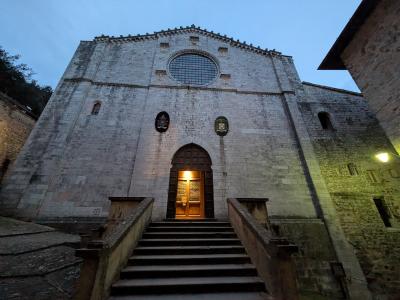
Cattedrale di San Giorgio
13th-century Gothic cathedral housing saints' relics
Architectural Monuments · Historic Churches
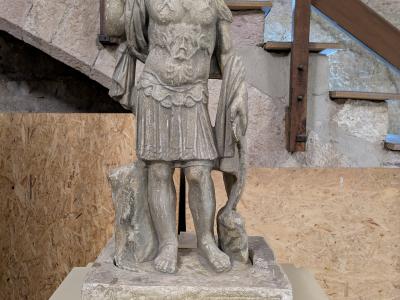
Museo Civico (Civic Museum)
Civic Museum in Gubbio's Palazzo dei Consoli
From €4 History & Heritage · Museums & Culture
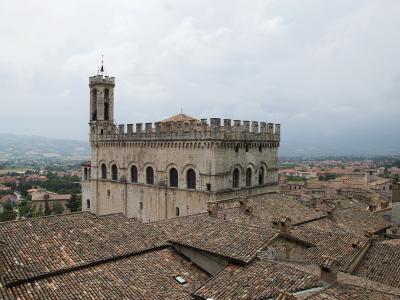
Palazzo dei Consoli
14th-century civic palace on Piazza Grande
From €5 Art Museums · Historic Palaces
Questions people ask
Quick Facts
Best Time to Visit
Visit between April and June or September and October for mild temperatures and fewer crowds.