Five days is enough to see all of Ischia without rushing, and it is the right length for the island's three real attractions: the sea-girt rock of the Aragonese Castle, the thermal water that comes out of the ground almost everywhere, and Monte Epomeo, the green-tuff volcano that fills the middle of the island. This route gives each of the island's coasts one day: the east with the castle (day 1), the north with Lacco Ameno and its Greek past (day 2), the west with Forio and the sunset coast (day 3), the interior with the climb of Monte Epomeo and the village of Sant'Angelo (day 4), and the south with the Maronti beach and the Cavascura canyon (day 5). Every day is built around a bus ride from your base, not a drive, so you do not need a car.
Read the season note before you book anything. Ischia's big thermal parks run from April to October and then shut. In 2026 Negombo closed on 11 October, Giardini Poseidon closes on 31 October, and the La Mortella gardens close on 1 November. If you are reading this in late autumn, winter or early spring, the island is still excellent, quiet and warm by northern standards (sunny winter days reach about 13 to 15 degrees, according to local guides), and each day below says what still works. Days 1, 3 and 4 are the strongest winter days; days 2 and 5 lose their garden and thermal-park stops but keep the walking. Walking is modest on every day except day 4, which includes the climb of Monte Epomeo.
Book these before you go
- Ferry or hydrofoil from Naples. Nothing on this route needs advance tickets in autumn or winter; in summer buy your boat ticket a day or two ahead. Fast boats from Molo Beverello take about 60 minutes (Alilauro, Snav and Caremar); slower ferries from Calata Porta di Massa take about 90 minutes (Caremar and Medmar). One-way fares on the 2026 listings run from about €16 on the ferry to about €21 to €26 on a hydrofoil.
- Castello Aragonese. Tickets are sold at the castle; the published full price is €15 (castelloaragoneseischia.com). No advance booking is needed.
- Giardini Poseidon, Negombo and Cavascura (summer only). Buy at the gate; see the days for dates and prices.
- Your return boat. In winter the last Naples-bound sailings leave earlier and there are fewer of them. Check the departure the day before.
Which days work in winter
| Day | Main stops | November to March |
|---|---|---|
| 1 | Castle, Ischia Ponte | Works. The castle is closed for annual maintenance from 7 January until early March. |
| 2 | Lacco Ameno, Fungo rock, museum, La Mortella, Negombo | Half. The Fungo, the town and the museum work; La Mortella and Negombo are closed. |
| 3 | Forio, Soccorso church, Punta Imperatore, Sorgeto, Poseidon | Works, except Poseidon. Sorgeto's hot pools are free and open all year. |
| 4 | Monte Epomeo, Sant'Angelo | Works on dry, clear days. Wet tuff is slippery. |
| 5 | Maronti, Cavascura canyon | Half. The beach walk works; Cavascura is seasonal. |
Getting there and getting around
From Naples. Fast boats leave from Molo Beverello, below the Maschio Angioino; slow ferries leave from Calata Porta di Massa, a short walk away. Alilauro hydrofoils serve Ischia Porto and Forio; Snav and Caremar hydrofoils call at Procida on the way; Medmar and Caremar ferries run to Ischia Porto and Casamicciola. Ferries also run year round from Pozzuoli, which suits you if you arrive from the Campi Flegrei or the A1 motorway; the crossing is about an hour.
The three ports. Ischia Porto, in the north-east, has the most sailings and is the best base: the island's bus station is there and every circular line starts from it. Casamicciola, on the north coast, is served by Snav and Medmar. Forio, on the west coast, is reached only by hydrofoil. Pick your port by your hotel, not by the timetable.
Buses. The island is run by EAV Bus. Two circular lines, CD (clockwise) and CS (anti-clockwise), start and end at Ischia Porto and between them touch every town. Numbered lines fill in the gaps: line 1 runs to Sant'Angelo, line 5 to the Maronti, line 7 to Ischia Ponte, line 9 links Citara, Panza and Serrara Fontana. As published in March 2026, a single ticket costs €1.70, a 100-minute ticket €2.10 (bought from a bar, newsagent or ticket office), a ticket bought from the driver €2.20, and an all-day ticket €5.10. Children under 6 travel free. Buy day tickets before you board; drivers do not always carry them. Buses are crowded on summer afternoons and run less often in winter, so treat the times below as a plan to check against the EAV timetable.
Day 1 - Ischia Ponte: the castle and the old fishing quarter
09:00 - The Aragonese Castle: arrive at opening. Take line 7 from Ischia Porto to Ischia Ponte, the old fishing quarter, or walk the sea road in about half an hour. The castle stands on a rock islet at the end of a stone causeway, a few minutes' walk from the quay; a wooden bridge was replaced by the stone one under Alfonso V of Aragon in 1441, which gives the castle its name. The islet had around 2,000 residents, 13 churches, a seminary, an abbey and a garrison around 1700. British ships shelled it in 1809, and the roofless ruin of the cathedral of the Assunta is the best-known scar.
 The causeway and the old fishing quarter of Ischia Ponte, seen from the castle. Image: Abxbay, CC BY-SA 4.0, via Wikimedia Commons.
The castle opens every day at 9:00. Closing time changes with the season (the published time in late October was 19:00), and the last ticket is sold an hour and a half before closing. The full ticket is €15; ages 0 to 9 are free, ages 10 to 18 pay €6, over-70s €12. The route inside is close to 2 km and takes 1.5 to 2 hours, most of it outdoors and uphill. You pass through a 400-metre tunnel cut in the tuff, the Immacolata church with its tiled dome, the Poor Clares' underground cemetery, the Bourbon prison cells (the prison closed in 1851) and the terraces. A lift cut through the rock is described in local guides; confirm it is running at the ticket office if stairs are a problem.
11:30 - Ischia Ponte on foot, and an hour for the sea. Walk back across the causeway and spend an hour in the lanes of Ischia Ponte. The town was a fishermen's district and keeps its low pastel houses along the waterfront. The Museo del Mare is listed as open daily in winter, 10:30 to 12:30 and 15:00 to 19:00; confirm hours before you plan around it.
15:00 - Thermal afternoon in the winter, beach in the summer. In the warm months swim at Cartaromana, the bay just west of the causeway (bus lines C12 and C13 serve it), which is also listed among the island's free natural thermal spots. From November to March the big parks are closed, but the Terme Comunali in Ischia Porto (via delle Terme) are open all year, and some hotel spas, such as the Privilege Spa at Terme Manzi in Casamicciola, stay open all winter; we could not confirm day-visitor access or 2026-27 prices, so ask when you call.
Rain plan. The castle route is mostly outdoors, so in heavy rain spend the day at the thermal baths and leave the castle for a clearer morning.
Day 2 - The north coast: Lacco Ameno, the Greeks and the gardens
09:30 - Bus to Lacco Ameno. Take line 1 or 2 (or CS) from Ischia Porto to Lacco Ameno, the bus passes through Casamicciola Terme. Casamicciola is the town hit by the landslide of 26 November 2022, which killed twelve people. Reconstruction is slow: in 2026 the work on the Cuccufriddù riverbed returned to planning after the contract was revoked, and the municipality is funding works on the Santa Barbara slope. Visitors pass through without trouble on the main road and ferries and the harbour work normally. We could not confirm the state of side roads and footpaths above the town, so stay on the main road and do not walk into the cordoned-off streets.
10:15 - The Fungo and the waterfront. In Lacco Ameno the symbol of the town stands in the water: the Fungo, a ten-metre tuff stack that broke off Monte Epomeo and was shaped like a mushroom by the sea. The fountain in the centre of town is a convenient place to sit near the waterfront and the church of Santa Restituta, which stands on an older early Christian building. The earthquake of 1883 killed more than 2,300 people in Casamicciola and Lacco Ameno, and in the 1950s and 1960s the publisher Angelo Rizzoli built the hotels that made the town a resort.
 The Fungo, the mushroom-shaped tuff rock that is the symbol of Lacco Ameno. Image: Sailko, CC BY 3.0, via Wikimedia Commons.
11:00 - Villa Arbusto and Pithecusae: the first Greek colony in the West. Climb to Villa Arbusto, the 18th-century villa on Monte di Vico, uphill from the waterfront. It houses the archaeological museum of Pithecusae, which covers the Euboean Greek settlement of the 8th century BC, the first Greek colony in the western Mediterranean. The star is the Cup of Nestor, a drinking cup with a three-line Greek verse scratched on it, dated to roughly 700 BC and counted among the oldest examples of Greek writing. Published hours and prices conflict: the official ministry listing gives Monday to Wednesday 9:00 to 13:00 and Thursday to Sunday 9:00 to 13:00 plus 17:00 to 19:45, with a €8 full ticket, while another source shows Wednesday to Saturday until 17:00. Call the museum on 081 996103 before you go, and plan the visit for the morning. Winter hours are shorter and some rooms may be closed for maintenance.
 The entrance of Villa Arbusto, home of the archaeological museum of Pithecusae. Image: Roderich Kahn, CC BY-SA 4.0, via Wikimedia Commons.
13:00 - Lunch, then the beach or the garden. Walk down to the harbour for lunch. Afterwards there are two good choices, depending on the season.
15:00 - La Mortella (April to 1 November). The La Mortella gardens were created by Susana Walton, wife of the composer William Walton, on a rocky valley at Forio, and are the island's main garden. In 2026 they open from 2 April to 1 November, only on Tuesdays, Thursdays, Saturdays and Sundays, 9:00 to 19:00 (last admission 18:00). Tickets: €15 full price, €12 concession, €10 aged 12 to 18, €8 aged 6 to 11, free under 5. The pedestrian entrance is Via Francesco Calise 45; take the bus towards Forio from Lacco Ameno and ask for La Mortella. Allow 1.5 to 2 hours. Season dates for 2027 had not been published when we checked.
Alternatives. Negombo, the thermal park in the San Montano bay, runs from 23 April to about mid-October (23 April to 11 October in 2026, 23 April to 13 October in 2027); in 2026 a full day cost €70 in high season and €55 in low season, and it has no closing day. It is closed now. In winter, walk the bay of San Montano, where the hill of Monte Vico shelters a curve of dark volcanic sand. On a Monday, Wednesday or Friday, when La Mortella is shut, spend the afternoon on the Pithecusae museum and Santa Restituta.
Return to your base by bus in the late afternoon.
Day 3 - The west coast: Forio, the Soccorso church and the sunset
09:30 - Forio. Take the CS or CD bus to Forio from Ischia Porto, or the Alilauro hydrofoil if you are arriving from Naples. Forio has about 17,000 residents and keeps a medieval core built around the Torrione and Piazza Municipio. The Torrione is a round defensive tower of the 15th century, one of several watchtowers built to warn against raids by pirates; it houses a small museum, whose hours we could not confirm. Walk the lanes behind it for an hour; shops and wine bars stay open into the evening.
 The round Torrione tower in Forio, one of the island's old coastal defence towers. Image: Pigiox, CC BY-SA 4.0, via Wikimedia Commons.
11:00 - The Soccorso church. The white church of Santa Maria del Soccorso stands on a headland at the edge of the old town. It dates from the 14th century, has a tiled staircase up to the door, and its forecourt faces the sunset; entry is free and it is open in daytime. The Madonna del Soccorso festival is held in mid-September. Come back here at sunset if you have the legs for it.
 The white church of Santa Maria del Soccorso on its headland at Forio. Image: Sailko, CC BY-SA 4.0, via Wikimedia Commons.
12:30 - The south-west cliffs: Punta Imperatore. Punta Imperatore is the southern end of Ischia's west coast, a high cliff of layered dark tuff with a lighthouse on top, close to Citara beach and Panza. There is no admission fee and no opening hours for the grounds; paths are uneven and steep in places and there is little shade, so take sturdy shoes and water. Take a taxi from Forio, or the bus towards Panza and walk; we could not confirm the exact stop, so ask the driver. Read more on the Punta Imperatore page.
 The cliff of Punta Imperatore at the south-west end of Ischia. Image: Dr.Conati at Italian Wikipedia, Public domain, via Wikimedia Commons.
15:00 - Poseidon Gardens or Sorgeto. In summer take the afternoon in Giardini Poseidon, the island's biggest thermal park, behind Citara beach in Forio. In 2026 it is open from 18 April to 31 October, 9:00 to 19:00 (to 18:00 from 1 October). A full day cost €50 and an afternoon ticket from 13:00 to 19:00 €45, with a €5 refundable wristband deposit (a third-party listing, August 2026); the park itself lists only a phone number for prices (+39 081 908 71 11).
In winter, go to Baia di Sorgeto, below the village of Panza. Hot springs at the sea edge mix with the cold sea and make natural pools that are free and open at any hour all year; pool temperatures can reach about 37 degrees. Access is down a staircase of roughly 200 to 300 steps (sources disagree), with paid parking at the top (about €3 to €4 a day). Wear water shoes, bring no valuables, and go at low tide: the heat varies with the tide, and in winter low tide can leave hot stones exposed that burn bare feet. In summer a taxi boat runs from Sant'Angelo.
 The rocks of Sorgeto Bay, where hot springs flow into the sea. Image: Sailko, CC BY 3.0, via Wikimedia Commons.
17:30 - Back to Forio for the sunset on the Soccorso forecourt, then dinner in town. Wear a layer; the wind rises after sunset. Check the last bus before you settle into dinner.
Day 4 - Monte Epomeo and Sant'Angelo
08:30 - Bus to Fontana. Monte Epomeo is 789 m high, the highest point of Ischia, a block of volcanic tuff uplifted in the island's volcanic history. The simplest way up begins at Fontana, a village of the Serrara Fontana municipality, at about 460 m. Line 9 links Forio, Panza and Serrara Fontana and line 11 links Barano and Fontana; from Ischia Porto expect to change. Fares are the normal EAV fares. Taxis from Fontana can shorten the first paved stretch.
 Monte Epomeo rising behind Forio. Image: Roberto De Martino, Public domain, via Wikimedia Commons.
09:30 - The climb: 60 to 75 minutes, easy but steep. The classic trail from Fontana is about 3 km with a climb of roughly 330 m. The first part follows the old military road, then enters a gorge cut in the tuff. Local guides call it easy and well marked, and walkers' reports from 2025 describe it as wide and well trodden, though very damp in the gorge. Wear shoes with grip: wet tuff is very slippery. The alternative from Forio starts at the Bosco della Falanga (about 580 m) and takes 45 to 60 minutes, but is less marked. The route via Pietra Mosca is longer and harder (about 90 minutes, 410 m of climb). Trail access is free. We found no 2026 report of any trail closure after the 2022 landslide, which came down on the north side above Casamicciola, but we could not find a current status from the municipality either; ask at your hotel before you start, especially after rain.
 The small hermitage church of San Nicola, cut into the tuff below the summit. Image: Dr.Conati at Italian Wikipedia, Public domain, via Wikimedia Commons.
11:00 - The summit and the hermitage. Just below the top the church of San Nicola is cut into the tuff, a hermitage dating from 1459. It now holds the Museo Epomeo and entry is free. On a clear day the summit gives a view over the whole island and the Gulf of Naples. Allow about an hour at the top, then descend the way you came (45 to 60 minutes).
14:00 - Sant'Angelo. Get down to Sant'Angelo by bus or taxi (check the EAV timetable; line 1 serves Sant'Angelo). Sant'Angelo is a car-free village of white houses and a tuff islet joined to the island by a sandy isthmus. Cars stop above the village and you walk down, or take a small electric cart. A path from the islet leads to the church of San Michele Arcangelo, built where a Benedictine abbey once stood; the English fleet shelled the islet in 1808 and a powder-magazine explosion ruined the abbey. Entry to the beach and village is free.
 Sant'Angelo and its tuff islet, joined to the village by a sandy isthmus. Image: Tiesse, Public domain, via Wikimedia Commons.
In summer a taxi boat runs from Sant'Angelo to the Maronti and the Cava Petrelle fumaroles for a few euros, and a path from the village also leads to the Maronti. Line 1 runs from Sant'Angelo to Forio and Ischia Porto for the return.
Rain plan. In rain skip the climb; the tuff is slick and the view is lost in cloud. Do day 1 or the museum on day 2 instead and move the climb to a clear morning; plan the swap on the day you wake up.
Day 5 - The Maronti, Cavascura and the way home
09:00 - Bus to the Maronti. Take line 5 from Ischia Porto (via Pilastri, Piedimonte and Testaccio) to the Maronti, the long beach on the island's south coast, backed by tuff cliffs. In winter the beach is empty and many of its bars are shut.
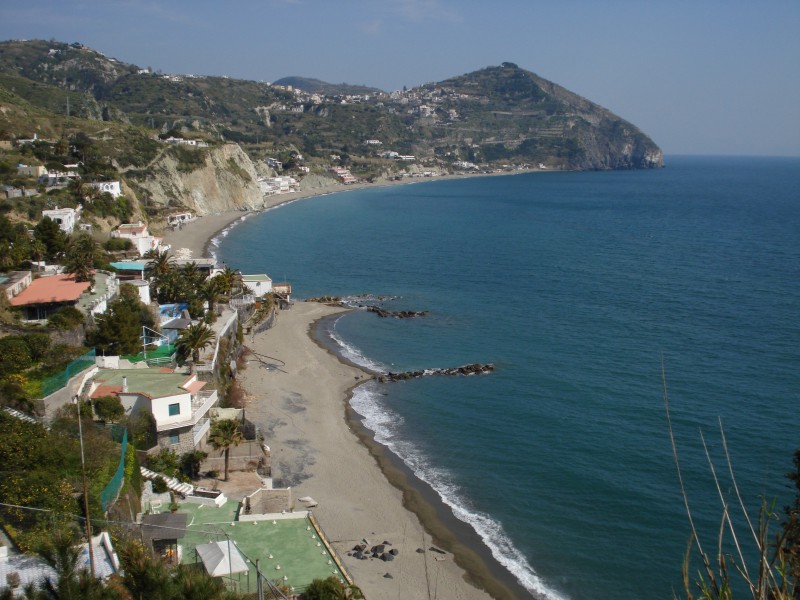 The Maronti, the long dark-sand beach on Ischia's south coast, seen from the cliffs above. Image: Grauesel, CC BY-SA 3.0, via Wikimedia Commons.
10:00 - Fumaroles and the Cavascura canyon. Near the Sant'Angelo end of the Maronti the Cava Petrelle fumaroles still vent heat from underground; local guides say it cooks eggs. The Cavascura canyon is reached on foot by following a warm stream into a narrow gorge in the tuff; sources give the walk from the beach as 5 to 20 minutes, so allow the longer. Inside are thermal bath niches and a steam cave. The spa's own listing says the spring was already a place of note in Roman times, and that it reopened to the public in 1988 after changing management several times. Cavascura is a seasonal paid facility, listed as open April to October, about 8:30 to 18:00. A third-party guide reports about €2 for entry and about €20 for a full-day package with a stone tub, lounger, steam cave and shower, but could not be confirmed with the operator. Access is on foot only: there is no road into the canyon, and the thermal zone is for ages 3 and over and unsuitable for wheelchairs and pushchairs. Water shoes are essential, and food and drink are sold only at the beach bars, about 300 m away. Because the spa is small and fills up, arrive early or book by phone (081 999242).
 A vaulted niche cut into the white tuff of the Cavascura canyon. Image: Evelyscher, CC BY-SA 4.0, via Wikimedia Commons.
The listings call Cavascura seasonal, so in winter assume the canyon is closed and confirm by phone; the fumaroles are open ground and need no ticket.
13:00 - Lunch and an easy afternoon. Eat at the Maronti or in Barano, then take the bus back to Ischia Porto for your boat. If you want one more thermal soak before you go, summer visitors can use the Aphrodite Apollon gardens at Sant'Angelo (€40 for the day, €30 from 13:00 in 2026), and winter visitors the Terme Comunali.
Boat home. Fast boats to Naples leave Ischia Porto, Casamicciola and Forio through the day; in winter the number is reduced. Be at the quay 30 minutes before departure and keep a margin of one boat.
The five days at a glance
| Day | Time | Stop | Allow | Book ahead? |
|---|---|---|---|---|
| 1 | 09:00 | Aragonese Castle | 2 hours | No; €15 at the gate |
| 1 | 11:30 | Ischia Ponte | 1 hour | No |
| 1 | 15:00 | Cartaromana or Terme Comunali | 2 hours | Call in winter |
| 2 | 10:15 | Lacco Ameno and the Fungo | 1 hour | No |
| 2 | 11:00 | Villa Arbusto and Pithecusae museum | 1.5 hours | Check hours by phone |
| 2 | 15:00 | La Mortella (to 1 November) | 2 hours | No; Tue, Thu, Sat, Sun only |
| 3 | 09:30 | Forio old town and Torrione | 1.5 hours | No |
| 3 | 11:00 | Soccorso church | 30 minutes | No |
| 3 | 12:30 | Punta Imperatore | 1.5 hours | No |
| 3 | 15:00 | Poseidon (to 31 October) or Sorgeto | 3 hours | No |
| 4 | 09:30 | Monte Epomeo from Fontana | 3 to 4 hours | No |
| 4 | 14:00 | Sant'Angelo | 2 hours | No |
| 5 | 10:00 | Maronti and Cavascura | 3 hours | Phone ahead (summer) |
Off-season version: November to April
Most of what makes Ischia famous in summer is closed from about the end of October, but the island does not shut. Plan it this way.
- Thermal water. Giardini Poseidon (18 April to 31 October in 2026) and Negombo (23 April to 11 October in 2026; the 2027 season opens on 23 April) are closed. The Terme Comunali in Ischia Porto are listed as open all year, and the Privilege Spa at Terme Manzi in Casamicciola stays open all winter. Many family-run hotels with thermal pools close from November to March, so call first. The free natural pools at Sorgeto, the Maronti fumaroles and Cartaromana stay open; local guides put the water at Sorgeto above 25 degrees in December and January.
- Sights. The castle is open daily until the maintenance closure that starts on 7 January and lasts until early March. The Pithecusae museum opens with reduced hours, and Museo del Mare in Ischia Ponte is listed as open daily, 10:30 to 12:30 and 15:00 to 19:00. La Mortella closes on 1 November. The Ravino botanical garden in Forio is listed as open in winter only on Wednesday afternoons.
- Days. Do days 1, 3 and 4 as written, using Sorgeto instead of Poseidon. On day 2 drop La Mortella and Negombo and add a longer walk around Lacco Ameno and the San Montano bay. On day 5 walk the Maronti and the fumaroles and skip Cavascura.
- Boats and buses. Hydrofoils and ferries from Molo Beverello, Calata Porta di Massa and Pozzuoli continue all year, but with fewer departures than in summer. Local sources date the summer timetable from around Easter to early November, and the winter timetable differs; check the day before you travel.
- Weather. Sunny winter days reach about 13 to 15 degrees; nights rarely fall below 5 to 7. The sea is about 19 degrees in November. Many restaurants and shops close in the cold months.
- Events. Christmas lights and nativity scenes appear in all six towns, the living nativity at Campagnano has been held on three days in late December, and Forio holds a carnival.
Where Procida fits
Procida, the smaller island between Ischia and the mainland, is not part of this itinerary, but its ports are on the way: Snav and Caremar hydrofoils from Naples stop there before Ischia. If you have a sixth day, see the Procida destination page rather than shortening one of these five. We did not confirm whether a Naples ticket allows a stopover, so buy a separate ticket for the Ischia-Procida leg.
Practical notes
Where to stay. Ischia Porto or Ischia Ponte suits this plan best, because every circular bus begins at the Ischia Porto bus station. Forio suits day 3 and 4 but is a long ride from the east.
Bus tickets. Sold at bars, tobacconists, newsagents, travel agents and the EAV office in Piazza Trieste.
Free hot pools. Natural springs such as Sorgeto have no lockers and no entry fee, and hot water at the seabed mixes with the sea, so the temperature changes with the tide; test the water with a hand first.
Sea and weather. The sea averages about 21 to 22 degrees in October and about 19 degrees in November, a cool swim. Winter days reach about 13 to 15 degrees, with minimums of 5 to 7. Winter crossings are cancelled in rough weather, so leave a day's margin if you have a flight.
Mondays and holidays. La Mortella is closed Monday, Wednesday and Friday; the Pithecusae museum has reduced hours; the castle opens every day except in its January to March maintenance closure.
What first-timers get wrong. They arrive in November expecting the thermal parks to be open; they climb Epomeo on wet tuff; they walk into Sorgeto at low tide in bare feet; and they leave the Naples return to the last boat of the day.
Prices and times are as published in October 2026; check ferry timetables, bus fares and the opening hours of the thermal parks before you travel.