The Venice Carnival 2027 runs from Saturday 23 January to Tuesday 9 February 2027, the date given on the official site, carnevale.venezia.it, and announced by the mayor at the close of the 2026 edition. The last day is Martedì Grasso, Shrove Tuesday, the day before Lent begins. Most of the street events, the mask parades and the water processions are free; the evening shows, the masked balls and the official dinner show are ticketed. As of October 2026 the theme and the day-by-day programme for 2027 had not been published, so this guide uses the 2026 edition to show how the eighteen days are usually laid out, and marks clearly what is confirmed for 2027 and what is not.
The carnival has deep roots. The official site dates the first written evidence to 1094; it was revived in 1979 after almost two centuries of absence. Today it is organised by the city of Venice through its events company, Vela, with events in the historic centre, on the islands and on the mainland in Mestre.
 The Shrove Thursday festivities in the Piazzetta, painted by Gabriel Bella between 1779 and 1792, now in the Querini Stampalia collection. Image: Sailko, CC BY 3.0, via Wikimedia Commons.
Venice Carnival 2027 dates at a glance
- Carnival period: Saturday 23 January to Tuesday 9 February 2027.
- Giovedì Grasso (Shrove Thursday): 4 February 2027.
- Martedì Grasso (Shrove Tuesday), the last day: 9 February 2027.
- Official Dinner Show at Ca' Vendramin Calergi: 30 and 31 January, then every night from 4 to 9 February 2027, dinner from 21:00.
Everything else in the programme, including the opening water parade, the Festa delle Marie and the mask contest, will be dated when the city publishes the 2027 programme, usually in the weeks before the start. In 2026 the full programme appeared in mid-January.
The opening weekend and the water parade
In 2026 the carnival opened on its first Saturday with a costumed Grand Ball in Piazza San Marco from 17:00. The next morning at 11:00 came the Festa Veneziana, the traditional water parade on the Grand Canal: about a hundred decorated rowing boats, with rowers in costume, from Punta della Dogana to Rialto, led by the Pantegana, a giant papier-mâché rat. The procession ends at the Erbaria, by the Rialto market, with music, dancing and food, and the official programme describes the bursting of the Pantegana under the Rialto Bridge as the moment that marks the start of Carnival.
If the 2027 edition follows the same pattern, the water parade would fall on Sunday 24 January. Watch from the fondamenta near Rialto or from the Accademia and Rialto bridges, and arrive early. The vaporetto lines 1 and 2 on the Grand Canal are diverted during the parade.
The Festa delle Marie
The Festa delle Marie recalls an event the carnival organisers date to 973: during the celebrations at the church of San Pietro di Castello, twelve young Venetian women were kidnapped by pirates, then rescued after a chase organised by Doge Pietro Candiano III. The festival was celebrated for centuries in changing forms and was revived in 1999 by the director Bruno Tosi.
 The twelve Marie in Renaissance dress during their parade at the 2018 Carnival. Image: Monica Rondoni, CC BY-SA 4.0, via Wikimedia Commons.
Today twelve young women from the Venice area are chosen at the start of Carnival and appear throughout the festival in historical costume. In 2026 the sequence was:
- Selection of the twelve Marie: the first Saturday, at the Scuola Grande di San Giovanni Evangelista.
- First public outing: the second Saturday, with a gondola procession along the Grand Canal at 15:00 and their presentation on the stage in Piazza San Marco at 16:00.
- Election of the Maria of the Year: the evening of the last Monday, in the Sale Apollinee of La Fenice theatre.
- Presentation of the Maria of the Year: Martedì Grasso at 16:00, on the Piazza San Marco stage.
The gondola procession is the best part to see: stand on the Grand Canal between Santa Sofia and San Marco, or wait in the Piazzetta for the arrival.
The mask contest: La Maschera più Bella
The parade for La Maschera più Bella, "the most beautiful mask", takes place on the stage in Piazza San Marco, with several shows on most weekend days. In 2026 more than 200 masks paraded over eight days, from historical eighteenth-century costumes to superheroes, and a jury of costume makers and artists chose the winners on the last Sunday afternoon. There are prizes for the most beautiful, the most elaborate and the best costume on the year's theme. A separate children's parade, the Mascherina più Bella, is held in Piazza Ferretto in Mestre.
 Costumed visitors in Piazza San Marco, with the clock tower behind. Image: EvelinaRibarova, CC BY-SA 4.0, via Wikimedia Commons.
Is the Volo dell'Angelo happening in 2027?
The Volo dell'Angelo, the "flight of the angel" in which a costumed performer descends by cable from the bell tower of San Marco to the piazza, was long one of the best-known events of the carnival, together with the related Volo dell'Aquila and Svolo del Leon. None of the three appears in the programme announcements for the 2025 and 2026 editions published on carnevale.venezia.it, which we checked in October 2026. Whether they return in 2027 is not yet known. If you are planning a trip around the flight, wait for the 2027 programme before booking.
Giovedì Grasso and the last weekend
The busiest stretch is the final week, from Giovedì Grasso to Martedì Grasso. In 2026, Giovedì Grasso brought a historical re-enactment in Piazza San Marco, the Taglio della Testa del Toro (the "cutting off the bull's head"), which recalls Doge Vitale Michiel II's victory in 1162 over the Patriarch of Aquileia and his twelve rebel vassals. Later that week came the Regata de Carneval, a race of two-oared mascarete boats on the Grand Canal, and on the last two days the Carnevali della Tradizione, with traditional carnival masks from other Italian regions on the San Marco stage.
 Two costumed figures under the arcades of Piazza San Marco at night, 2019. Image: Naturpuur, CC BY 4.0, via Wikimedia Commons.
Through all eighteen days, the Commedia dell'Arte plays on wooden stages in the Piazzetta San Marco and Campo Santo Stefano, and the Venice Carnival Street Show brings performers to the campi of Venice, the centre of Mestre and the islands. Parades of allegorical floats take place in Dese, Chirignago, Pellestrina, the Lido, Marghera, Burano, Campalto, Mestre and Zelarino, mostly at weekends.
The Arsenale water show and the Dinner Show
In recent editions the Darsena Grande of the Arsenale has been the stage for an evening show on the water, which the organisers call a long-standing tradition. In 2026, Il Richiamo di Olympia used fountains, light projections, acrobats and fire, with two performances a night at 18:45 and 21:00 over nine evenings. Tickets were sold online and at Venezia Unica sales points, and a special boat ran from San Zaccaria for ticket holders only. The 2027 show had not been announced as of October 2026.
The Official Dinner Show at Ca' Vendramin Calergi, the palace on the Grand Canal, is the most formal event. For 2027 it is confirmed for 30 and 31 January and every night from 4 to 9 February, with dinner from 21:00. Period costume is required (evening dress and dinner jackets are not accepted), and guests must be over 18. Tickets went on sale on 27 July 2026 through the official carnival website.
Masks and costumes: what to wear
You do not need a costume to enjoy the carnival, but many visitors wear at least a mask. The official site picks out four traditional disguises:
- Bauta: probably the best-known Carnival mask, simple and unadorned, which let the wearer join parties without being recognised.
- Tabarro: the large black cloak worn with the bauta, which hid the whole body.
- Moretta: an oval black velvet mask once worn by women, held in place by a button gripped between the teeth, so the wearer could not speak.
- Gnaga: a cat-faced mask worn by men dressed as women, a satire of social roles.
 The bauta and tabarro in Pietro Longhi's eighteenth-century painting "The Visit in Bauta", Ca' Rezzonico. Image: Didier Descouens, Public domain, via Wikimedia Commons.
Masks were a social leveller: masked Venetians greeted each other with "Buongiorno, Siora Maschera" (Good day, Madam Mask), whoever was underneath. In 2026 the Carnival's culture programme included mask-making and decorating sessions in several of the city's mask workshops; look for them in the 2027 programme.
 A group in floral costumes at a café table in the Piazzetta, with the Doge's Palace behind. Image: Monica Rondoni, CC BY-SA 4.0, via Wikimedia Commons.
What to eat: frittelle, castagnole and galani
Carnival is the season for frittelle (fritoe in Venetian), fried dough balls. The traditional version has raisins and pine nuts; others are filled with custard, zabaglione or chocolate. Pastry shops also sell castagnole, small fried balls, and galani, thin, crisp strips of fried pastry dusted with icing sugar, known elsewhere in Italy as chiacchiere or crostoli. The official site traces galani back to the Roman Saturnalia.
Crowds, the access fee and practical tips
The two weekends and the days from Giovedì Grasso onwards draw the biggest crowds, especially around Piazza San Marco and the Rialto. The first week is calmer and a better choice if you want to photograph costumes without a crowd around them.
The access fee (contributo di accesso). Venice charges day visitors a fee on a calendar of days set by the city. When we checked in October 2026, the 2027 calendar had not been published, so it is not yet known whether any Carnival days will be included. Check the official site, cda.ve.it, before you travel; it lists the days, the amount, the exemptions and how to book.
Getting there and around. Trains arrive at Venezia Santa Lucia and buses at Piazzale Roma, both at the top of the Grand Canal. The official site recommends buying transport and museum passes in advance through Venezia Unica, the city pass, to avoid queues. Expect vaporetto diversions on parade days.
Other tips:
- Book accommodation early for the last weekend and Martedì Grasso.
- Keep to the right on bridges and do not stop on them to take photos.
- Dress for cold, damp weather. Late January and early February in Venice are often foggy, and high water can flood Piazza San Marco.
- Respect the costumed participants. Ask before posing next to someone for a photo.
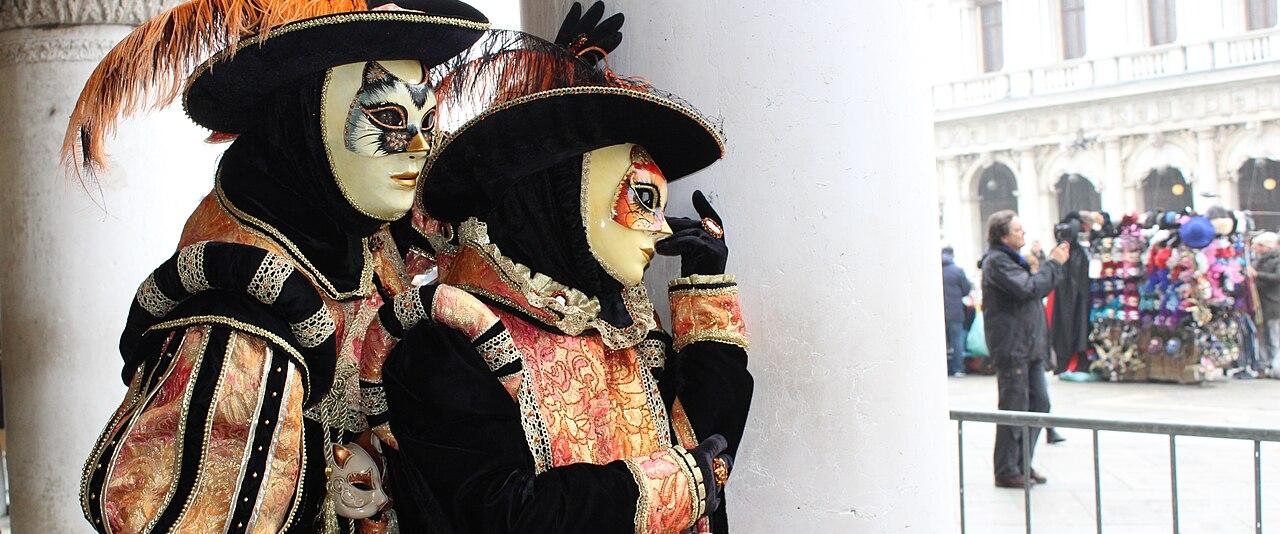
 Two masked figures in elaborate costume on the waterfront, Carnival 2010. Image: Frank Kovalchek from Anchorage, Alaska, USA, CC BY 2.0, via Wikimedia Commons.
For more of the city once the carnival crowds thin out, see our guide to Venice's quieter neighbourhoods and our day trip to Murano and Burano.