Palermo's oldest market
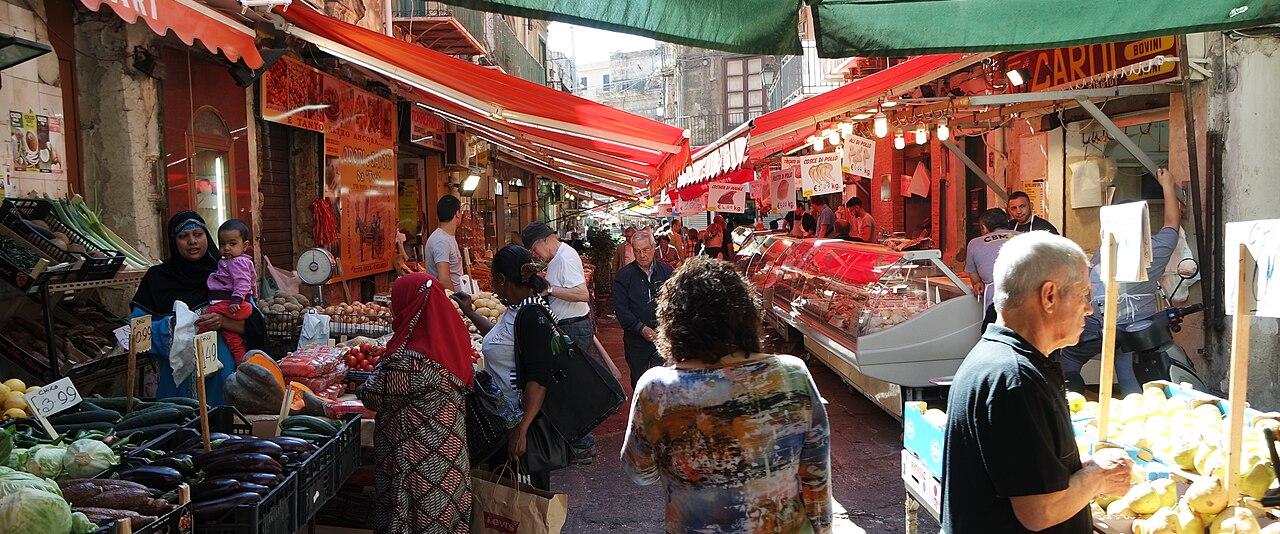
Palermo has several historic street markets, including the Vucciria and the Capo, but Ballarò is considered the oldest and is still the one most used by residents for daily shopping. It occupies a long run of streets in the Albergheria quarter, one of the four historic districts of the old city, stretching from Piazza Casa Professa south-east towards Corso Tukory and the old walls near Porta Sant'Agata.
The origin of the name is uncertain. Theories link it to Bahlara, a village near Monreale from which Arab-era merchants are said to have come, to Arabic phrases for a market or fair, or to later family and personal names. What is clear is that the market's layout of narrow lanes and covered stalls recalls the souks of North Africa, and that it has been a food market for centuries.
What the market sells
Ballarò is first of all a working food market. Stalls sell fruit and vegetables from the Palermo countryside, fish and shellfish, meat, olives, capers, dried tomatoes, spices and household goods. Prices are generally lower than in supermarkets, and much of the produce is seasonal and local.
Part of the experience is the sound. Vendors shout their wares in a traditional sing-song call known as the abbanniata, advertising what is fresh and what it costs. Space is tight, with crates pushed out into the lane and scooters threading through, so keep bags in front of you and be ready to step aside.
Midway through the market rises the majolica-tiled dome of the church of Carmine Maggiore, a useful landmark, and the Jesuit church at Casa Professa stands at its northern end.
The street food to try
Palermo has one of the strongest street-food traditions in Italy, and Ballarò's fryers and grills are among the best places to try it. Look for:
- Panelle: thin fritters of chickpea flour, often eaten in a soft sesame bun.
- Crocchè (also called cazzilli): potato croquettes flavoured with mint or parsley, frequently served with panelle in the same bun ("pane, panelle e crocchè").
- Arancine: fried rice balls, in Palermo called by the feminine arancina and typically round. Classic fillings are meat ragù with peas or ham and cheese with béchamel.
- Pani ca' meusa (pane con la milza): a bun filled with slices of veal spleen and lung simmered in lard, served either plain or "maritata" with caciocavallo cheese or ricotta. It is Palermo's best-known street dish and an acquired taste.
- Sfincione: a thick, soft Palermitan pizza topped with tomato, onion, anchovy, oregano and breadcrumbs, often sold in squares.
- Stigghiola: skewered lamb or kid intestines wrapped around spring onion and grilled over charcoal, sold from smoking street grills.
- Polpo bollito: boiled octopus, cut to order and seasoned with lemon.
- Quarume: boiled veal offal, served with salt, lemon and pepper.
In winter you may find boiled or baked onions and artichokes cooked over coals. For something sweet, look for cannoli filled to order with sheep's-milk ricotta, or an iris, a fried brioche filled with ricotta and chocolate chips.
When to go
The market is busiest from the morning into the early afternoon, when stalls are fully stocked and the fryers are working. Many fish and produce stalls start to pack up after lunch. Sundays are quieter, with fewer stalls trading. In the evenings parts of the area around the market are known for informal grills and bars, especially at weekends, but the full market experience is a morning one.
Tips for visiting
- Carry cash in small notes and coins. Many stalls do not take cards, and street food is sold in small portions at low prices.
- Eat where locals queue. A busy stall with fast turnover usually means the oil is hot and the food freshly made.
- Ask before photographing vendors up close, and do not block stalls while taking pictures.
- Watch your belongings, as you would in any crowded market.
- Wear closed shoes. The lanes can be wet from ice melting under fish displays.
- Pace yourself. Fried food is filling; sharing several items lets you taste more.
If you are curious but unsure what to order, a walking food tour run by a local guide can help with names and fillings. Otherwise, pointing and asking "Cos'è?" (what is it?) usually works.
Combining Ballarò with nearby sights
Ballarò lies close to several of Palermo's main monuments. The Royal Palace with the Palatine Chapel, the church of San Giovanni degli Eremiti and Palermo Cathedral are all within a walk of roughly ten to fifteen minutes, as is the Quattro Canti crossroads, with the churches of the Martorana and San Cataldo. A morning combining the market with the Arab-Norman monuments makes a good introduction to the city.
The Capo market, north-west of the cathedral, offers a similar mix of produce and street food and is worth visiting on a second day for comparison. The Vucciria, near the port, is now smaller as a daytime market and better known for its evening street life.
A note on the neighbourhood
Albergheria is one of the poorer quarters of central Palermo and has a mixed, multicultural population, with shops run by residents from South Asia, West Africa and elsewhere alongside long-established Palermitan families. In recent years, local associations have worked to improve the area. It is lively and generally safe during market hours, but, as anywhere in a big city, keep valuables out of sight.