







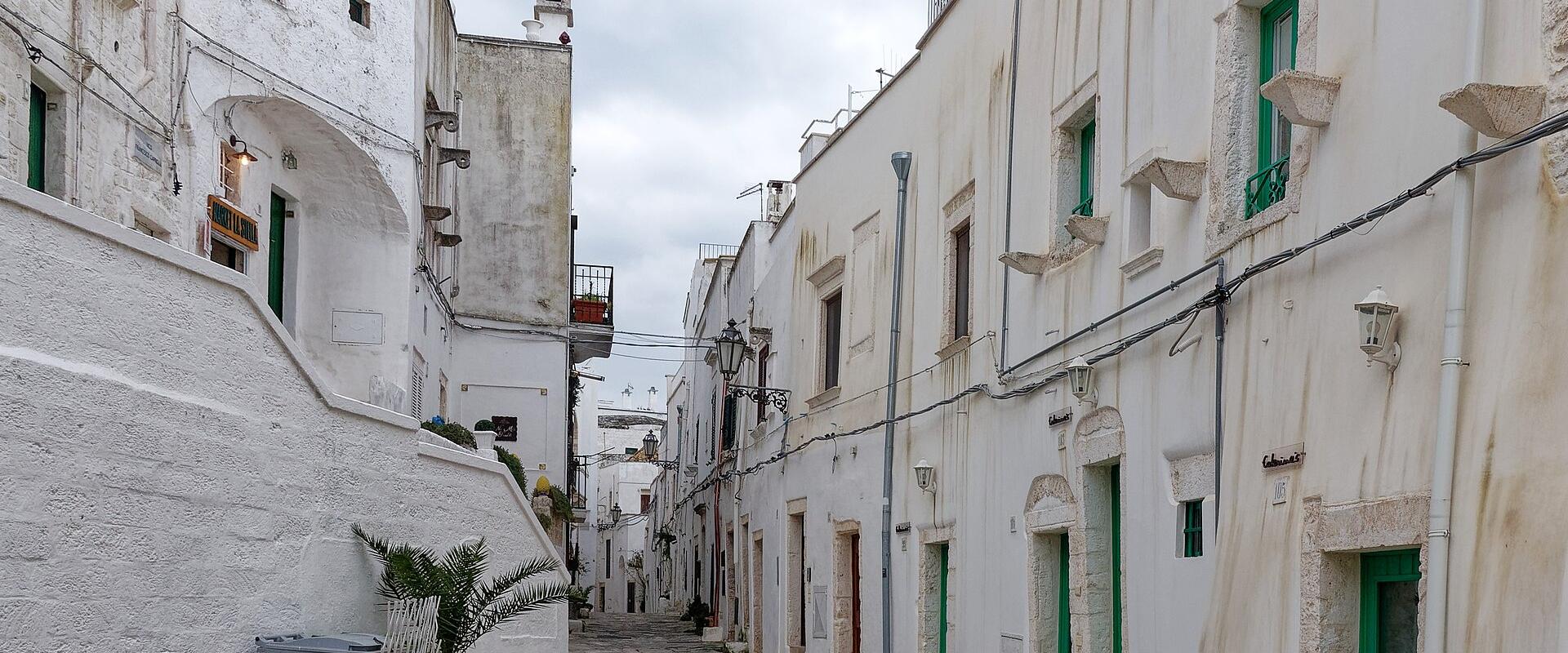
Il Centro Storico (The White City)
White-washed historic center on a 218m promontory
- Where
- Ostuni, Apulia
- Directions
- Directions
Il Centro Storico in Ostuni, known as the White City, is a striking historic district perched on a promontory about 218 meters high, near the Adriatic coast of Puglia, north of Brindisi, at the point where the Itria Valley and the edge of the Salento peninsula meet. The town’s distinctive appearance results from the tradition of whitewashing building facades with lime, a practice that reflects the sun and keeps interiors cool. This visual uniformity creates a serene and cohesive atmosphere as visitors navigate the narrow, winding streets of the old town. Seen from the plain, especially at sunset, the town appears as a pile of white houses on the hill, with the cathedral at the summit, and it can be seen from far away across the olive groves.
The historic center offers a rich cultural experience, anchored by significant landmarks such as the Cathedral of Santa Maria, which features a mix of Gothic and Baroque styles. Built in the 15th century, in a late Gothic style with Venetian influence, the cathedral has a facade with a large rose window of 24 rays, flanked by smaller ones, and crowned by a pediment, while the interior was altered in the Baroque period. Piazza della Libertà is a central gathering point, surrounded by historic buildings and the Column of Sant'Oronzo, a monument dedicated to the city’s patron saint, who is believed to have saved Ostuni from the plague in the 17th century. The square also has the Palazzo del Municipio, formerly a convent, and the cafes where locals gather.
Exploring the area allows visitors to discover numerous churches, including the Church of St. Francis of Assisi, and various small museums that highlight the region’s heritage. Behind the squares, the lanes climb and turn, with steps, arches, and covered passages that link the houses, and the walls are brilliant white, with doors and shutters painted in blue or green, and pots of geraniums. Many of the buildings have a Gothic or Baroque doorway, and many shops and restaurants occupy the ground floors of old houses. The town’s ancient history is in evidence in the site of the Grotta di Santa Maria di Agnano, near Ostuni, where in the 1990s the skeleton of a pregnant young woman, Delia, who lived about 25,000 years ago, was found, one of the finest finds of prehistoric Europe.
While specific opening hours and admission fees for the historic center itself are not applicable as it is a public urban area, individual sites like the cathedral and museums have their own schedules and entry requirements. Visitors are advised to check local information for specific times. The experience of walking through Il Centro Storico is one of discovery, with panoramic views of the Adriatic Sea and surrounding olive groves from various vantage points. The area’s millennia-old history, ranging from prehistoric origins to its current status as a tourist destination, is evident in its architecture and layout.
This setting provides a peaceful environment for appreciating traditional Puglian life and architecture. The best times to visit are the early morning and the evening, when the lanes are quiet and the light is warm, and in the middle of the day in summer the heat can be fierce. In August, the town celebrates its Cavalcata, a procession of horsemen in costume in honor of Sant'Oronzo, with a procession of lit floats, a tradition that attracts people from all around.
Categories
More photos coming soon
Nearby Attractions
Other places to visit in Ostuni
Questions people ask
Quick Facts
Best Time to Visit
Visit between April and June or September and October for mild temperatures and fewer crowds.