







- Where
- Naples, Campania and Amalfi Coast
- Directions
- Directions
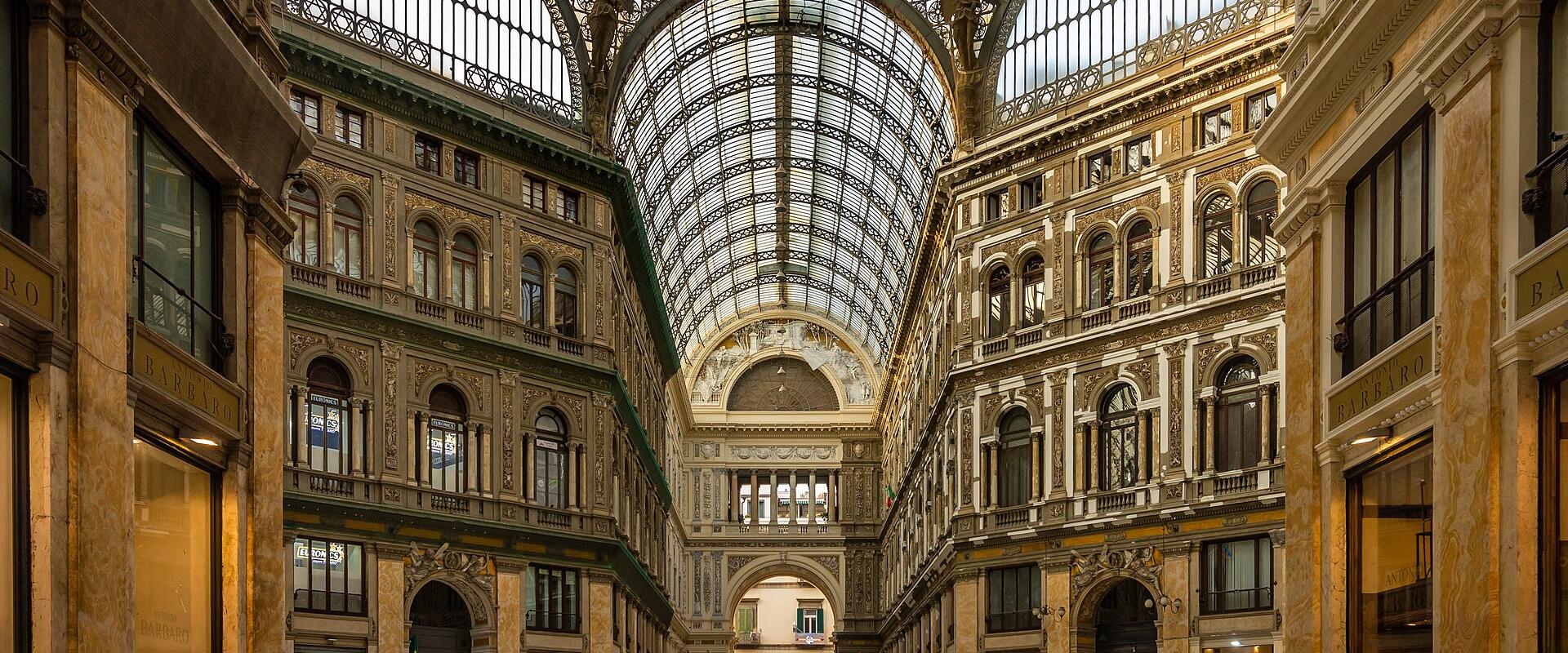
The Galleria Umberto I is one of the great shopping arcades of Italy, a spectacular cross-shaped glass-roofed gallery in the centre of Naples, on the edge of the historic centre that is a UNESCO World Heritage site. It stands directly across from the Teatro di San Carlo, the opera house, and near the Royal Palace and the Castel Nuovo, and a short way from the Duomo, in the UNESCO World Heritage-listed centre, and it links Via San Carlo to Via Roma, the great street that was formerly Via Toledo, the main street of the city, and which many Neapolitans still call by its old name. The gallery was built between 1887 and 1890 and was designed by the architect Emanuele Rocco, who took inspiration from the Galleria Vittorio Emanuele II in Milan, though the Neapolitan version has its own character.
Its origins lie in a dramatic chapter of the city’s history. In 1884, a terrible cholera epidemic killed thousands of people in the dense, unhealthy slums of Naples, and the government launched an ambitious programme of urban renewal, known as the risanamento, the cleansing, which demolished crowded old quarters and built new streets and public buildings. The Galleria Umberto I was part of this programme, and it was built on the site of a demolished district, on the new broad street, as a symbol of the modern, healthy city that was meant to replace the old one. It was named in honour of King Umberto I, who was on the throne at the time, and the style that it represents is known as Stile Umbertino, the Umbertine style, a florid, eclectic style of the late 19th century.
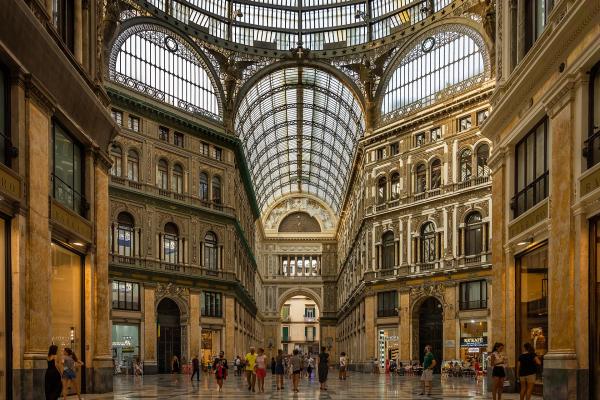
The gallery is cruciform, with four arms that meet under a central octagon, which is covered by a soaring dome of iron and glass nearly sixty metres high. The structure of iron ribs and glass panes lets light flood into the space, and the effect is of a great indoor piazza. The floors are laid with mosaic in patterns, including a design with the signs of the zodiac, and the facades inside the gallery are decorated with columns, statues and balconies in a Neo-Renaissance style, with elaborate cornices and ironwork. Functioning as an indoor piazza, the gallery houses shops, cafes and offices, together with apartments on the upper floors, so that it is a living part of the city. In the years after the Second World War, it was known as a place for street children and shoe-shiners, who inspired a famous Italian film.
The gallery is open to the public, and entry is free, and it is a natural place to shelter from the rain or the heat, and to stop for a coffee. It can be visited on walking tours of the historic centre. A visit takes half an hour or so, longer if you linger in a cafe. It is a short walk from the Castel dell’Ovo, the Certosa e Museo di San Martino, the Museo Archeologico Nazionale di Napoli (MANN), the Quartieri Spagnoli, the Sansevero Chapel and Spaccanapoli, and a little farther are the Parco Nazionale del Vesuvio and other sights. The gallery suits lovers of 19th-century architecture, shoppers and anyone who wants to see a more elegant side of Naples. Morning is the quietest time.
Categories
More photos coming soon
Nearby Attractions
Other places to visit in Naples
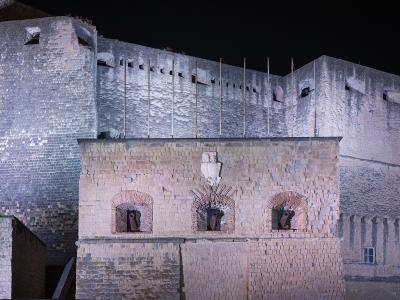
Castel dell'Ovo
Naples' oldest castle, known as the Egg Castle
Free Castles & Fortresses · Local Folklore
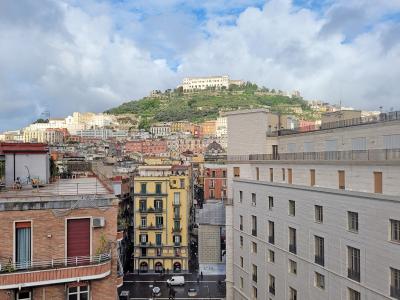
Certosa e Museo di San Martino
14th-century Carthusian monastery with panoramic Naples v...
History & Heritage · Museums & Culture

Museo Archeologico Nazionale di Napoli (MANN)
World's largest Greek-Roman art collection
Archaeological Museums · Art Museums

Parco Nazionale del Vesuvio
Active volcano and national park in Naples
Geological Sites · Hiking Trails
Questions people ask
Quick Facts
Best Time to Visit
Visit between April and June or September and October for mild temperatures and fewer crowds.