







- Admission
- Free
- Hours
- Open road accessible at all times
- Where
- Terracina, Lazio
- Directions
- Directions
The Via Appia Antica is the most famous of all Roman roads, the Queen of Roads, as the Romans called it, and at Terracina, on the coast of southern Lazio, it meets the sea. The road was begun in 312 BC by the censor Appius Claudius Caecus, after whom it is named, to link Rome with Capua, and it was later extended to Brindisi on the Adriatic coast, the port of embarkation for Greece and the East, over a total distance of some five hundred kilometres. It was a major piece of engineering, built of massive stone paving laid on a deep foundation of layers, and it remained in use for centuries. After running south from Rome across the plain, it crosses the Pontine Marshes in a long straight line, and then reaches the town of Terracina, the ancient Anxur, at the foot of the cliffs.
In Terracina, the road passes through the town and then through a spectacular obstacle. A limestone headland, Pisco Montano, blocks the coast road, and the Romans solved the problem by cutting a huge notch through the rock, a gap some thirty metres high. On the rock face, they carved Roman numerals at intervals, which record the depth of the cut at each level, and these marks are still visible, a reminder of the scale of the work, which is attributed to the emperor Trajan in the early 2nd century AD. This passage is one of the sights of the town, and visitors can see it from the old road, which still follows the original line.
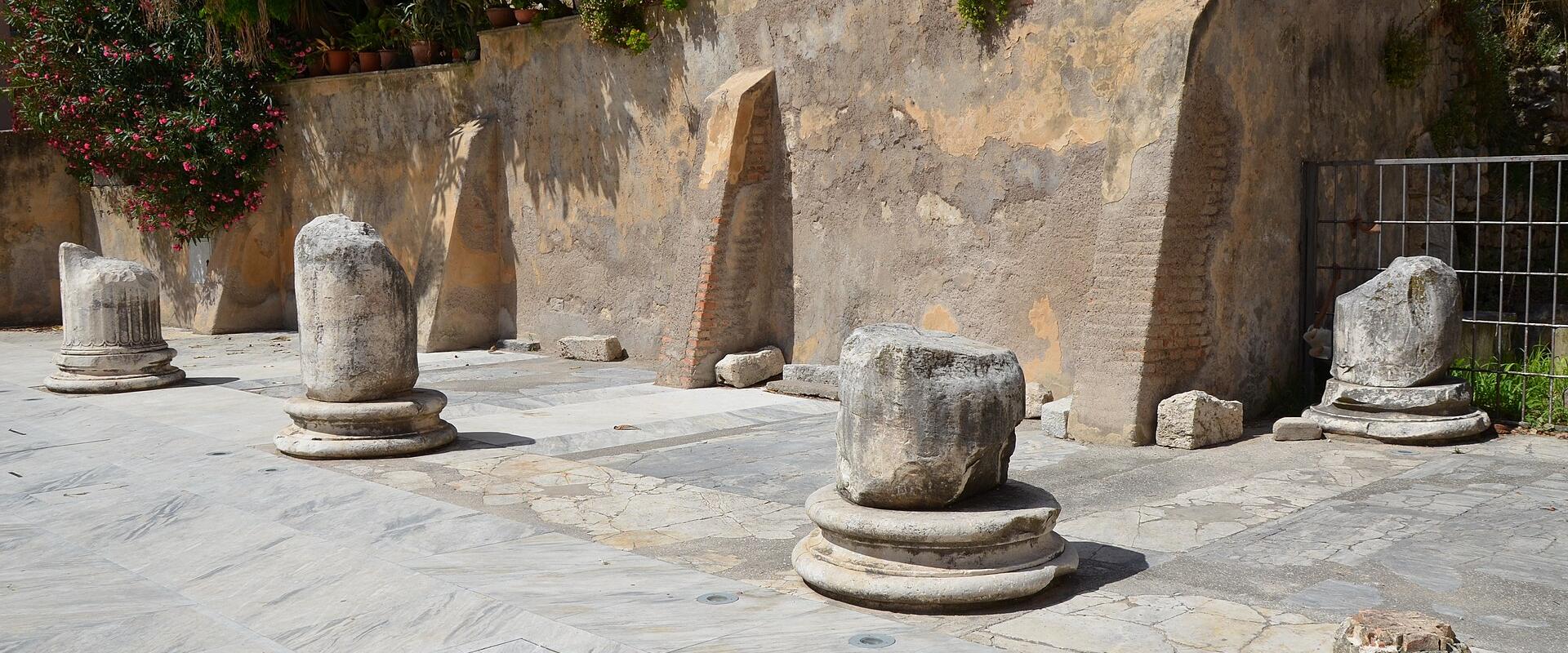
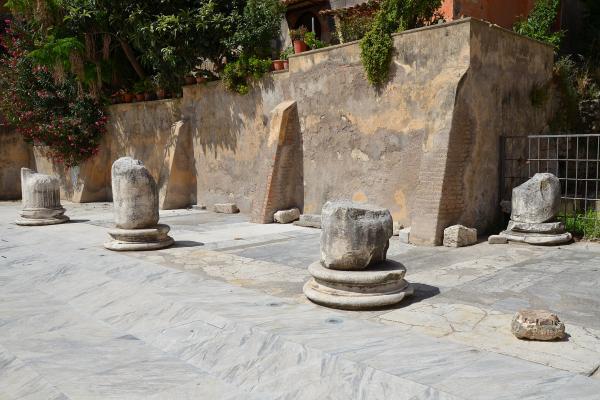
The road retains its original stone paving in several sections, large polygonal blocks of grey stone worn smooth by centuries of traffic, and walking on them is a direct link with the Roman world. In the lower town, the road becomes the main street of the ancient city, passing the Roman forum, now Piazza del Municipio, with its large paving and the cathedral of San Cesareo, which was built on the site of a Roman temple. Above the town, on the cliff, stand the remains of the Temple of Jupiter Anxur, with huge arched substructures and a terrace that looks across the sea, one of the most striking Roman monuments in Lazio. The road runs parallel to the coast, with views across the Gulf of Gaeta to the mountains, and toward the promontory of Monte Circeo to the north-west.
As an open road, the Via Appia Antica is accessible at all times, and the sections of paving can be walked or driven, though the traffic of the modern town uses some stretches. Specific archaeological sites and museums along the route have their own opening hours, so check them separately. The road works as a link between the historic centre and the beach areas, so that ancient infrastructure is part of daily life. A walk takes an hour or two, depending on how far you go. The Temple of Jupiter Anxur is the main site to combine with it. The Appian Way is the oldest of the great roads; the Cathedral and the Roman Forum are on the route, while the temple stands above. The route suits lovers of ancient history, walkers and anyone who enjoys the idea of following in the footsteps of Roman legions and travellers.
Categories
More photos coming soon
Hours & Fees
- Open
- Open road accessible at all times
- Admission
- Free
Hours and prices change, especially out of season. Check with the venue before you go.
Nearby Attractions
Other places to visit in Terracina
Questions people ask
Quick Facts
Best Time to Visit
Visit between April and June or September and October for mild temperatures and fewer crowds.