







- Admission
- Free first Sunday of month with reservation
- Hours
- Tue-Sun 8:30 am–7:15 pm (last entry 6:00 pm); Closed Mon, May 1, Dec 25, Jan 1
- Where
- Milan, Lombardy
- Directions
- Directions
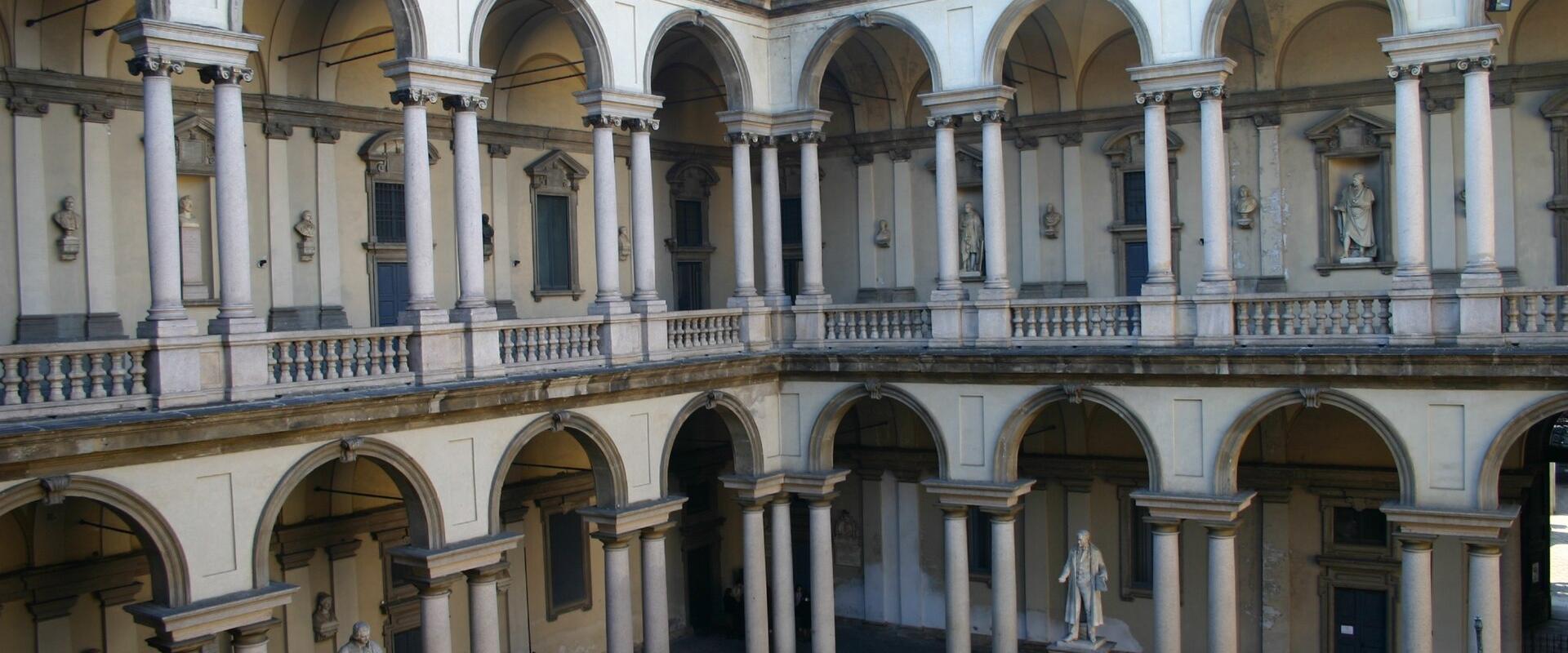
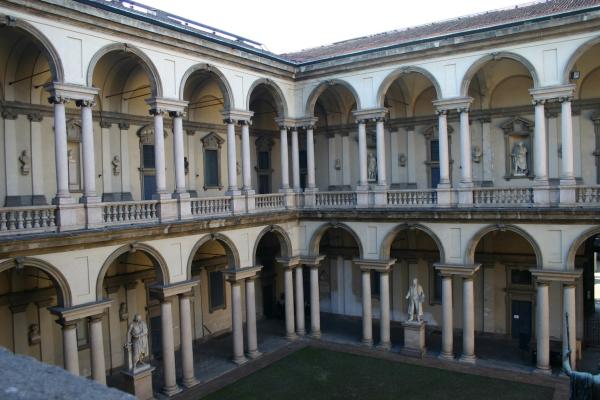
The Pinacoteca di Brera in Milan is one of Italy’s most important art galleries, located at Via Brera 28, in the quarter of the same name, a district of narrow streets, bookshops and small restaurants a short walk north of the Duomo. It houses a vast collection of masterpieces, including works by Raphael and Caravaggio, showcasing the evolution of Italian painting from the Middle Ages to the 19th century. The museum is housed in a former Jesuit complex, the Palazzo di Brera, adding to its historical and architectural significance. The palace was built for the Jesuits in the late 16th century as a college, and its elegant two-story courtyard, designed by the architect Francesco Maria Richini in the 17th century, with a statue of Napoleon as Mars the Peacemaker at its center, is worth seeing before one climbs the stairs to the galleries.
The gallery was created in the early 19th century, when Milan was the capital of Napoleon’s Kingdom of Italy. Following the suppression of religious orders and the closing of convents and churches, a flood of paintings came into the hands of the state, and the authorities gathered them at Brera to form a teaching collection for the neighboring Academy of Fine Arts, which shares the building. The museum opened to the public in 1809 and grew through acquisitions and donations, and today the building also houses a famous library and an academy, as well as an observatory and a botanical garden.
The rooms follow a chronological order, and the collection is especially strong in the art of northern Italy. Among the most famous works is Raphael’s Marriage of the Virgin, painted in 1504 when he was in his early twenties, in which the delicate figures are set before a temple in perfect perspective. Andrea Mantegna’s Dead Christ, with its dramatic foreshortening that places the viewer at the feet of the body, is one of the most striking images in Renaissance art. Caravaggio’s Supper at Emmaus, painted in 1606 while he was a fugitive, shows the moment when the disciples recognize the risen Christ, in strong light and dark. There are also major paintings by Piero della Francesca, Giovanni Bellini, Tintoretto and Veronese, and, in the later galleries, Francesco Hayez’s The Kiss, a celebrated romantic painting of the Italian Risorgimento.
The Pinacoteca is open Tuesday through Sunday and closed every Monday, as well as on some public holidays, and admission is free on the first Sunday of the month, though reservations are required. The museum offers an official app for immersive experiences, audio guides and themed tours. Visitors are advised to book tickets in advance, especially during peak seasons, to ensure entry. A visit takes about two hours for the highlights, longer for a fuller visit, and the galleries are generally calmer than the larger museums of other cities.
Exploring the Pinacoteca di Brera offers insight into Milan’s artistic heritage. It complements visits to other landmarks in Milan, such as the Duomo and the Sforza Castle, a short walk away, providing a view of the city’s identity. The Brera quarter outside, with its cafes and shops, is a pleasant place for a drink after the visit.
Categories
More photos coming soon
Hours & Fees
- Open
- Tue-Sun 8:30 am–7:15 pm (last entry 6:00 pm); Closed Mon, May 1, Dec 25, Jan 1
- Admission
- Free first Sunday of month with reservation
Hours and prices change, especially out of season. Check with the venue before you go.
Nearby Attractions
Other places to visit in Milan
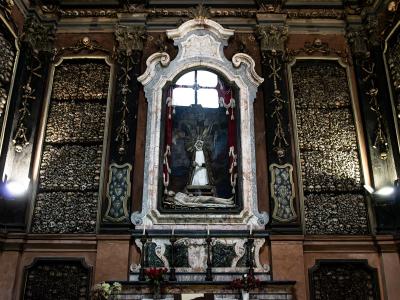
Bone Chapels (Catacombs Of The Ossuary)
13th-century ossuary with walls of human bones
Museums & Culture · Historic Cemeteries
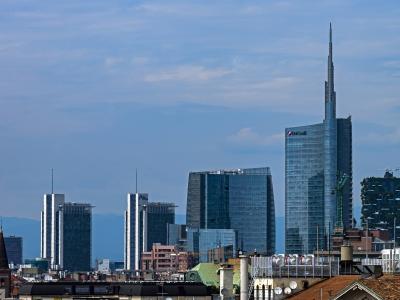
Bosco Verticale
Residential towers with 90+ plant species on facades
Free Architectural Monuments · Botanical Gardens
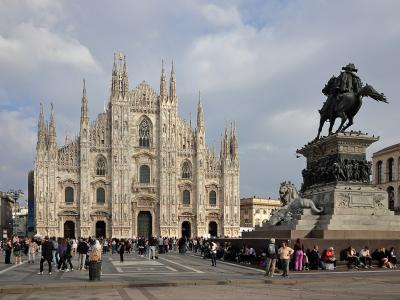
Duomo di Milano
Gothic cathedral with marble facade and rooftop terraces
Architectural Monuments · Cultural Tours
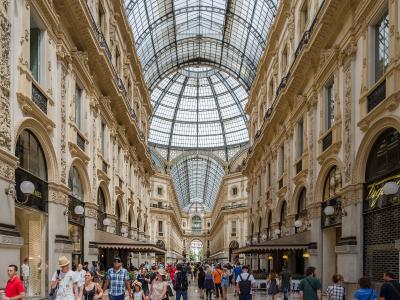
Galleria Vittorio Emanuele II
19th-century glass arcade with mosaic floors
Free Architectural Monuments · Shopping Streets
Questions people ask
Quick Facts
Best Time to Visit
Visit between April and June or September and October for mild temperatures and fewer crowds.